Can a contractor charge interest on late payments?
Yes, if your contract sets a lawful rate or a prompt pay law gives you one. Texas, Arizona and Minnesota rules, plus a $20,000 worked example.
Go straight to the late fee calculator Free, no signup. Read on if you want the detail first.Yes, if a contract or a statute gives you the right
Yes. You can charge interest on a late payment when your contract sets a rate your state allows, or when a prompt payment statute gives you interest whether the contract mentions it or not.
Texas, Arizona and Minnesota each have a prompt pay statute that sets interest at 1.5% a month on the late payments it covers. Where neither a clause nor a prompt pay statute applies, a default legal rate may: 6% a year in Texas, starting on the 30th day after the amount is due, 10% a year in Arizona, and 6% a year in Minnesota unless a different rate is contracted for in writing.
This guide reads the statutes of those three states. Other states have their own prompt pay and interest rules.
Source one: a rate written into your contract
A.R.S. 44-1201 sets interest on an obligation at 10% a year unless a different rate is contracted for in writing, and then any rate may be agreed. In Arizona, a rate other than 10% a year has to be in writing.
Texas Finance Code section 302.001 caps interest at 10% a year except as otherwise provided by law, and calls a higher rate usurious unless another law provides for it. Contracts for usurious interest are subject to the penalties in Chapter 305. Before you put a contract rate above 10% a year on a Texas job, have a Texas attorney confirm which law allows it.
If your Texas contract says nothing about interest, Finance Code section 302.002 lets you charge legal interest of 6% a year on the principal, starting on the 30th day after the amount is due.
Minnesota section 334.01, subdivision 1, sets interest on a legal indebtedness at $6 on $100 a year unless a different rate is contracted for in writing. It also bars taking more than $8 on $100 a year for the loan or forbearance of money, goods or things in action, and says interest is not compounded. Chapter 334 has exceptions, such as subdivision 2 for written credit contracts of $100,000 or more, so have a Minnesota attorney confirm a contract rate above that before you rely on it.
The contract side of the question, read from each state's general interest statute.
| State | No rate agreed | Rate in the contract |
|---|---|---|
| Texas | 6% a year, from the 30th day after the amount is due (Fin. Code 302.002) | Up to 10% a year except as otherwise provided by law (302.001) |
| Arizona | 10% a year (A.R.S. 44-1201(A)(2)) | Any rate, if contracted for in writing (44-1201(A)(2)) |
| Minnesota | $6 on $100 a year (Stat. 334.01, subd. 1) | In writing, and not over $8 on $100 a year for a loan or forbearance unless a chapter 334 exception applies |
A prompt pay statute can still give a higher rate on the payments it covers. See the next section.
Source two: a prompt payment statute
A prompt payment statute sets a payment deadline and attaches interest to a missed one. You do not have to write the rate into your contract for it to apply, though Arizona adds a condition for owner-occupied homes.
- Texas, Property Code chapter 28. An owner, meaning a person other than a governmental entity who ordered the improvement, must pay within 35 days after receiving your written payment request (28.002). An unpaid amount starts to accrue interest on the day after it was due, at 1.5% each month (28.004). A written contract for a single-family residence may set a later due date, but only one before the 61st day, and late amounts still bear 1.5% a month (28.006). Any other attempted waiver of the chapter is void.
- Arizona, A.R.S. 32-1182. The owner pays within 7 days after a billing is certified and approved, and a progress billing is deemed approved 14 days after the owner receives it unless the owner first issues a written statement of reasons. Late amounts bear interest at 1.5% a month or fraction of a month, or at a higher rate the parties agree. The act's definition of a construction contract covers written and oral agreements (32-1181).
- Minnesota, Statutes 337.10, subdivision 3. A prime contractor or subcontractor must pay its subcontractors and suppliers within 10 days of receiving payment for their undisputed work, with interest of 1.5% a month on undisputed amounts paid late. The minimum monthly interest penalty on an unpaid balance of $100 or more is $10.
On a contract for the construction of a dwelling for an owner-occupant in Arizona, section 32-1188 says the requirements of section 32-1182 do not apply unless the statutory legend, headed "Notice to owner of applicability of Arizona prompt pay act", or substantially similar language appears in clear and conspicuous type on the front page of each billing or estimate. Leave it off, and that homeowner is outside the 1.5% statute.
Minnesota's subdivision 3 governs what prime contractors and subcontractors pay their own subs and suppliers. It does not set the owner's deadline to pay the prime contractor. Subdivision 4 says the owner makes progress payments monthly unless the contract provides otherwise.
The three states side by side
Prompt pay deadlines and interest in the three states this guide covers.
| State | Who must pay | Deadline | Interest on late amounts | Fees if you sue |
|---|---|---|---|---|
| Texas | Private owner to contractor; contractor to sub | 35 days after a written payment request; 7 days after the contractor is paid | 1.5% a month from the day after due | Court may award costs and reasonable attorney's fees |
| Arizona | Owner to contractor, written or oral contract | 7 days after the billing is certified and approved | 1.5% a month or fraction of a month, or a higher agreed rate | Successful party is awarded costs and attorney fees |
| Minnesota | Prime and subs to their own subs and suppliers | 10 days after receiving payment for undisputed work | 1.5% a month, at least $10 a month on balances of $100 or more | Prevailing claimant is awarded costs and attorney fees |
Tex. Prop. Code 28.002, 28.004 and 28.005; A.R.S. 32-1182; Minn. Stat. 337.10, subd. 3.
What 1.5% a month does to a $20,000 invoice
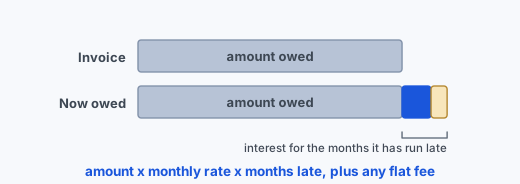
Here is a worked example, not a quote for your job. A $20,000 invoice goes unpaid and the rate is 1.5% a month. The late fee calculator charges simple interest prorated by day and counts 30 days as a month.
$20,000 invoice at 1.5% a month, no flat fee.
| Days late | Interest | Total now due |
|---|---|---|
| 15 | $150.00 | $20,150.00 |
| 30 | $300.00 | $20,300.00 |
| 45 | $450.00 | $20,450.00 |
| 60 | $600.00 | $20,600.00 |
| 90 | $900.00 | $20,900.00 |
1.5% a month equals 18% a year, or $10.00 a day on this balance.
A lower contract rate costs the payer less over the same 45 days. At 0.5% a month, which is 6% a year, the interest is $150.00 and it grows by $3.33 a day. At 1% a month, which is 12% a year, it is $300.00 and $6.67 a day.
The $20,000 invoice preset opens the calculator at this balance so you can change the days and the rate.
Arizona's act words its rate as 1.5% "a month or fraction of a month". The calculator prorates by day, so for a part month it shows a daily share rather than a full month.
In Texas, chapter 28 interest stops on the earliest of the day payment is delivered, the day it is mailed if it arrives within three days, or the day a judgment is entered (28.004).
How to word the clause
Put the rate in the signed contract and repeat it on every invoice, next to the due date. Say that the interest is simple, give the monthly rate, and say the day it starts.
Example wording, to adapt to your state: "Payment is due within [number] days after the invoice date. Any amount unpaid after the due date bears simple interest at 1.5% per month from the day after the due date until paid." In Arizona, a written rate like this is what lets you charge something other than 10% a year. In Texas, check a contract rate above 10% a year against section 302.001 first, and in Minnesota, check one above $8 on $100 a year against section 334.01.
If you build dwellings for owner-occupants in Arizona, print the section 32-1188 legend on the front page of each billing or estimate. Without it, the interest in 32-1182 does not apply to that owner.
Show the original amount, the days late and the interest as separate lines. Our guide on how to write a contractor invoice covers the rest of the invoice, and the contractor invoice template has room for your payment terms.
When interest alone does not get you paid
Texas lets a contractor or subcontractor suspend work on the 10th day after giving the owner written notice that an undisputed amount was not paid on time and that work will be suspended (28.009). The owner's lender must get the same notice when the conditions in 28.009(b) are met, such as a recorded construction loan. Minnesota lets an unpaid prime or sub suspend work when an undisputed payment is not received within ten days (337.10, subd. 3).
On a Texas detached single-family home, duplex, triplex or quadruplex, a party with a good faith dispute may withhold up to 110% of the difference in dispute (28.003).
If the money is still missing, a lien may be the next step. The notice of intent to lien template is a written warning you can send before you file.
Interest and prompt pay rules vary by state and change over time, so have a licensed attorney confirm your specific contract and situation.
Late fee calculator, Late fee on a $20,000 invoice, Late fee chart, Contractor invoice template. Free, no signup, nothing to install.
Questions people ask
Can a contractor charge interest on an unpaid invoice?
Yes, when the contract sets a lawful rate or a prompt pay statute applies. The Texas, Arizona and Minnesota prompt pay statutes all set 1.5% a month on the late payments they cover. Without either, Texas allows legal interest of 6% a year starting on the 30th day after the amount is due, and Arizona's default rate is 10% a year.
How much interest can a contractor charge on a late payment?
State law sets the ceiling. Arizona allows any rate agreed in writing. Texas caps interest at 10% a year except as otherwise provided by law, while its prompt pay chapter sets 1.5% a month by statute. Minnesota limits interest for a loan or forbearance to $8 on $100 a year outside the exceptions in chapter 334. On a $20,000 invoice, 1.5% a month comes to $450.00 after 45 days.
Can I charge a late fee if it is not in the contract?
None of the statutes in this guide creates a flat late fee for you. The nearest is Minnesota's $10 minimum monthly interest penalty on an unpaid balance of $100 or more, which applies only to the payments 337.10 covers. Interest is different. Texas chapter 28 and Arizona's prompt pay act attach 1.5% a month to the late payments they cover without a contract clause, though Arizona requires its statutory legend on billings to an owner-occupant. Texas also allows legal interest of 6% a year when no rate was agreed.
What is a prompt payment act?
It is a state law that sets deadlines for paying contractors and adds interest when they are missed. Texas gives a private owner 35 days after a written payment request. Arizona gives an owner 7 days after a billing is certified and approved. Minnesota gives a prime contractor or sub 10 days after it is paid to pay its own subs and suppliers.
Is 1.5% a month legal?
It is the rate the prompt pay statutes in this guide set: Texas chapter 28, Arizona 32-1182 and Minnesota 337.10 all use it. As a contract rate, Arizona allows it if it is in writing. In Texas, 1.5% a month equals 18% a year, above the 10% a year cap in Finance Code 302.001 unless another law provides for it, so have a Texas attorney confirm it before you use it outside chapter 28.
How should I word a late payment interest clause?
State the due date, the monthly rate, that the interest is simple, and the day it starts. For example: "Any amount unpaid after the due date bears simple interest at 1.5% per month from the day after the due date until paid." Put it in the signed contract and on each invoice, and use a rate your state allows.
Sources
- Texas Property Code, Chapter 28, Prompt Payment to Contractors and Subcontractors, Owner definition in 28.001, the 35 and 7 day deadlines in 28.002, disputes in 28.003, 1.5% a month in 28.004, fees in 28.005, waiver in 28.006, suspension in 28.009.
- Texas Finance Code, Chapter 302, Interest Rates, The 10% a year cap and usury rule, and 6% a year legal interest from the 30th day when no rate was agreed.
- Arizona Revised Statutes 32-1182, Progress payments by owner; conditions; interest, Deemed approval after 14 days in (D), 1.5% a month or fraction of a month in (Q), costs and attorney fees in (S).
- Arizona Revised Statutes 32-1188, Applicability to construction of a dwelling for an owner-occupant; definitions, The prompt pay legend required on each billing or estimate to an owner-occupant.
- Arizona Revised Statutes 32-1181, Definitions; applicability, A construction contract is a written or oral agreement.
- Arizona Revised Statutes 44-1201, Rate of interest for loan or indebtedness; interest on judgments; definitions, 10% a year unless a different rate is contracted for in writing.
- Minnesota Statutes 337.10, Building and construction contracts; prohibited provisions, Ten day payment to subs and suppliers, 1.5% a month, the $10 minimum, fees and suspension in subd. 3; monthly progress payments in subd. 4.
- Minnesota Statutes 334.01, Rate of interest, $6 on $100 a year unless a different rate is contracted for in writing, the $8 on $100 limit and no compounding in subd. 1, the $100,000 exception in subd. 2.