Self-Employment Tax on $50,000: $7,064.78 for 2026
Self employment tax on $50,000 of net profit is $7,064.78 under Schedule SE. See the table from $20,000 to $100,000 and why gross 1099 pay is wrong.
Go straight to the self-employment tax calculator Free, no signup. Read on if you want the detail first.Self-employment tax on $50,000 is $7,064.78
If your net profit is $50,000 for 2026, your self-employment tax is $7,064.78. That is $5,725.70 of social security tax plus $1,339.08 of Medicare tax, both figured on $46,175.00 of net earnings from Schedule SE.
Tax Topic 554 gives the rate as 12.4% for social security and 2.9% for Medicare, 15.3% together. You don't pay 15.3% of the full $50,000, because Schedule SE first multiplies your profit by 92.35%.
With no wage job, the tax works out to 14.1% of profit at every level in the table below, from $20,000 to $100,000.
Half of the tax, $3,532.39, comes back as a deduction when you figure income tax. To check your own figure, enter your profit in the self-employment tax calculator.
The $50,000 must be net profit, not your 1099 total
Self-employment tax is charged on net earnings, not on what clients paid you. Tax Topic 554 defines net earnings by subtracting ordinary and necessary trade or business expenses from gross income. For a sole proprietor that is the profit on Schedule C, line 31, which goes on Schedule SE, line 2.
Here is an example. Your 1099-NEC forms add up to $50,000 and you spent $14,000 on business expenses such as materials, tools, insurance and fuel. Your net profit is $36,000, and the self-employment tax on it is $5,086.64, not $7,064.78.
Every deductible cost you leave off raises this tax as well as your income tax. Business driving is easy to miss; the mileage deduction calculator figures that deduction for 2026.
Numbered invoices make the year's receipts easy to total, and how to write a contractor invoice covers what each one should show.
Schedule SE line by line for $50,000
Part I of the 2026 Schedule SE runs from line 1a to line 13. These are the lines that carry a number when your only income is $50,000 of Schedule C profit.
2026 Schedule SE, Part I, with $50,000 of net profit and no W-2 wages.
| Line | What it does | Amount |
|---|---|---|
| 2 | Net profit from Schedule C, line 31 | $50,000.00 |
| 4a | Line 3 times 92.35% | $46,175.00 |
| 4c | Net earnings; if less than $400, stop | $46,175.00 |
| 6 | Line 4c plus line 5b | $46,175.00 |
| 7 | 2026 maximum subject to social security tax | $184,500 |
| 8a | Social security wages, W-2 boxes 3 and 7 | $0.00 |
| 9 | Line 7 minus line 8d | $184,500.00 |
| 10 | Smaller of line 6 or line 9, times 12.4% | $5,725.70 |
| 11 | Line 6 times 2.9% | $1,339.08 |
| 12 | Self-employment tax, to Schedule 2, line 4 | $7,064.78 |
| 13 | Half of line 12, to Schedule 1, line 15 | $3,532.39 |
Lines 1a, 1b, 4b, 5a, 5b and 8b to 8d are zero in this example. Amounts from the self-employment tax calculator.
The 92.35% on line 4a is printed on the form, and line 4a applies it whenever line 3 is more than zero. As arithmetic it is 100% minus 7.65%, and 7.65% is half of the 15.3% combined rate.
Line 12 goes to Schedule 2, line 4, and is paid along with your income tax on Form 1040.
Self-employment tax from $20,000 to $100,000
2026 self-employment tax by net profit, single filer, no W-2 wages.
| Net profit | Net earnings | Social security | Medicare | SE tax | Half deducted |
|---|---|---|---|---|---|
| $20,000 | $18,470.00 | $2,290.28 | $535.63 | $2,825.91 | $1,412.96 |
| $30,000 | $27,705.00 | $3,435.42 | $803.45 | $4,238.87 | $2,119.43 |
| $40,000 | $36,940.00 | $4,580.56 | $1,071.26 | $5,651.82 | $2,825.91 |
| $50,000 | $46,175.00 | $5,725.70 | $1,339.08 | $7,064.78 | $3,532.39 |
| $60,000 | $55,410.00 | $6,870.84 | $1,606.89 | $8,477.73 | $4,238.87 |
| $75,000 | $69,262.50 | $8,588.55 | $2,008.61 | $10,597.16 | $5,298.58 |
| $100,000 | $92,350.00 | $11,451.40 | $2,678.15 | $14,129.55 | $7,064.78 |
Each row is from the self-employment tax calculator. The tax is 14.1% of profit in every row.
So $30,000 of net profit carries $4,238.87 of self-employment tax, and $20,000 carries $2,825.91.
The share stays flat because none of these rows reaches the 2026 social security limit of $184,500, and Tax Topic 554 says all of your net earnings are subject to the Medicare tax.
If you also have a W-2 job
Your W-2 wages and your self-employment earnings share one $184,500 social security base. Schedule SE line 8a takes the total of boxes 3 and 7 from your W-2 forms, and line 9 subtracts it from $184,500. Social security tax is charged only on whatever base is left.
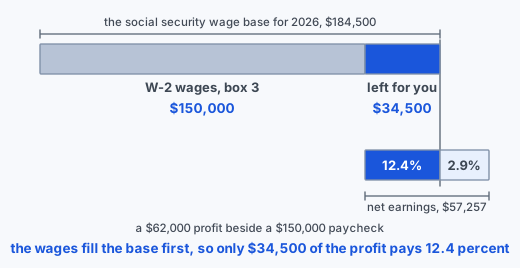
Self-employment tax on $50,000 of net profit with different W-2 social security wages, 2026, single.
| W-2 social security wages | Base left, line 9 | Social security | SE tax |
|---|---|---|---|
| $0 | $184,500.00 | $5,725.70 | $7,064.78 |
| $40,000 | $144,500.00 | $5,725.70 | $7,064.78 |
| $150,000 | $34,500.00 | $4,278.00 | $5,617.08 |
| $190,000 | $0.00 | $0.00 | $1,339.08 |
Medicare is $1,339.08 in every row. Amounts from the self-employment tax calculator.
A job under the base changes nothing: with $40,000 of wages the tax is still $7,064.78. At $150,000 of wages only $34,500.00 of base is left, so social security tax falls to $4,278.00.
High earners also owe Additional Medicare Tax of 0.9% on Form 8959. The Form 8959 instructions set the thresholds at $250,000 for married filing jointly, $125,000 for married filing separately and $200,000 for every other status, and say they are not indexed for inflation. Medicare wages reduce the threshold for self-employment income. With $190,000 of Medicare wages, a single filer's threshold for self-employment income drops to $10,000, so $36,175.00 of the $46,175.00 of net earnings is over it, which adds $325.58.
The half you deduct
Schedule SE line 13 is half of line 12. On $50,000 of profit that is $3,532.39, and it goes on Schedule 1, line 15. Tax Topic 554 confirms you can deduct one-half of the self-employment tax.
The deduction lowers the income your income tax is figured on. It does not lower the self-employment tax itself, which stays $7,064.78, because line 13 is figured from line 12 after the tax is known.
With wages, the deduction shrinks with the tax. At $150,000 of W-2 wages it is $2,808.54, half of $5,617.08.
Under $400 of net earnings, there is no self-employment tax
Schedule SE line 4c says that if net earnings are less than $400, you stop: you don't owe self-employment tax. Because of the 92.35% step, net profit has to be a little over $400 to cross that line.
For example, $433 of net profit gives $399.88 of net earnings and $0.00 of tax. At $450 of profit, net earnings are $415.58 and the tax is $63.58.
The floor is for self-employment tax only, and the Schedule SE instructions give church employee income its own threshold of $108.28.
This is not your whole tax bill
The $7,064.78 is self-employment tax alone. Federal income tax and any state income tax come on top, so 14.1% of profit is one part of what to set aside, not the full answer.
To plan payments for the whole bill, the quarterly estimated tax calculator works from last year's total tax, which already includes self-employment tax. Don't add the two figures together.
Spread over four payments, the self-employment part on $50,000 is $1,766.19 a quarter, before any income tax.
Build the cost into your prices: the hourly rate calculator works back from the income you want, your overhead and the hours you can bill.
Schedule SE also builds your Social Security record. Tax Topic 554 says the Social Security Administration uses the information from Schedule SE to compute your benefits.
Tax rules vary with your filing status, other income and state, so have a licensed tax professional confirm the figures for your own situation.
Self-employment tax calculator, Quarterly estimated tax calculator. Free, no signup, nothing to install.
Questions people ask
How much self-employment tax do I pay on $50,000?
$7,064.78 for 2026, if the $50,000 is net profit and you have no W-2 wages. That is $5,725.70 of social security tax plus $1,339.08 of Medicare tax on $46,175.00 of net earnings.
Is self-employment tax figured on gross or net income?
Net. You subtract ordinary and necessary business expenses from gross income first. $50,000 of 1099 income with $14,000 of expenses is $36,000 of profit, and $5,086.64 of self-employment tax.
Why does Schedule SE use 92.35%?
Line 4a of Schedule SE tells you to multiply net profit by 92.35% (0.9235) before any tax is figured. It equals 100% minus 7.65%, which is half of the 15.3% combined rate. On $50,000 it gives $46,175.00.
Does a W-2 job change my self-employment tax?
Only when wages and self-employment earnings together pass the $184,500 social security base for 2026. With $40,000 of wages the tax on $50,000 of profit stays $7,064.78; with $150,000 of wages it drops to $5,617.08.
Is half of self-employment tax deductible?
Yes. Schedule SE line 13 is half of the tax and goes on Schedule 1, line 15. On $50,000 of profit it is $3,532.39. It lowers income tax, not the self-employment tax.
Do I owe self-employment tax if I made under $400?
Not if your net earnings on Schedule SE line 4c are less than $400. Net profit of $433 gives $399.88 of net earnings and no tax; $450 of profit gives $63.58.
How much self-employment tax is owed on $30,000?
$4,238.87 for 2026 on $30,000 of net profit with no W-2 wages. On $20,000 it is $2,825.91, and on $40,000 it is $5,651.82.
Sources
- IRS, Schedule SE (Form 1040) 2026, Self-Employment Tax, Lines 2 to 13, the 92.35% step, the $400 stop on line 4c and the $184,500 base on line 7.
- IRS, Instructions for Schedule SE (Form 1040) (2026), The 2026 maximum of $184,500, who must file and the $108.28 church employee income threshold.
- IRS, Tax Topic 554, Self-employment tax, The 12.4% and 2.9% rates, net earnings, the half deduction and the Social Security link.
- IRS, Instructions for Form 8959 (2025), Additional Medicare Tax, The 0.9% rate, the $200,000, $250,000 and $125,000 thresholds, which are not indexed for inflation, and the threshold reduced by Medicare wages.