Can I Pay All My Estimated Taxes at Once?
Yes, you can pay all your 2026 estimated tax at once, but a lump sum in January does not erase penalties for earlier quarters. See the IRS timing rules.
Go straight to the quarterly estimated tax calculator Free, no signup. Read on if you want the detail first.The short answer: yes, if the money goes in early
Yes. You can pay your whole 2026 estimated tax in one payment, and Form 1040-ES says so directly: you can pay all of it by April 15, 2026, or in four equal amounts by the four due dates.
What one payment cannot do is reach back in time. The penalty is figured separately for each installment, so a lump sum in September or January does not cover the dates that already went by short.
So the timing decides it. One payment on or before the first date you owe covers the whole year. One payment after that still helps, because it stops the oldest shortfall from running any further, but it does not erase the days that already ran.
Why a late lump sum does not fix earlier dates
The rule is in the Form 2210 instructions. The penalty is figured separately for each installment due date, so you can owe it for an earlier date even if you paid enough later to make up the shortfall. That is true even if you end up with a refund.
Each date has its own required amount. Under the regular method that is one fourth of the required annual payment. A shortfall on April 15 is charged from April 15 until the day it is paid, and Form 1040-ES puts it plainly: the penalty is imposed on each underpayment for the number of days it remains unpaid.
Payments also go in a set order. Your payments are applied first to any underpayment on an earlier installment, even if you mark the payment for a later period. Labeling a check as the fourth quarter does not move it past an older shortfall.
The IRS gives its own example. You had a $500 underpayment left after the April 15 payment, and on June 10 you paid $1,200 meant for June 15. The first $500 goes to April, the April penalty runs from April 15 to June 10 (56 days), and $700 is left for the June installment.
Worked example: $9,000 required for 2026
Say the total tax on your 2025 return was $9,000, your 2025 adjusted gross income was $60,000, and you expect to owe $11,000 for 2026. Nothing is withheld from a paycheck.
The quarterly estimated tax calculator compares 100 percent of last year's tax, $9,000.00, with 90 percent of this year's, $9,900.00. The smaller one binds, so the required annual payment is $9,000.00. Spread over four dates, that is $2,250.00 a date.
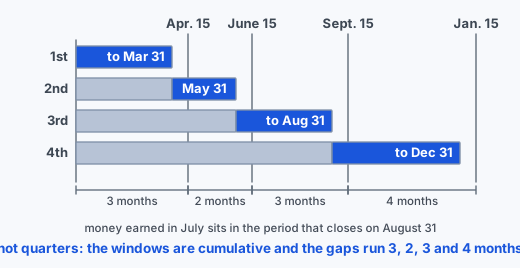
Where the 100 and 90 percent figures come from, and the cases where you owe no estimates at all, are covered in the first-year estimated tax post. This page is only about timing.
Three ways to pay the same $9,000.00, from the quarterly estimated tax calculator. The first two are on time; the third is one lump on the last date.
| Due date | Four payments | One payment April 15 | One payment Jan. 15 |
|---|---|---|---|
| April 15, 2026 | $2,250.00 | $9,000.00 | $2,250.00 short for 275 days |
| June 15, 2026 | $2,250.00 | Already covered | $2,250.00 short for 214 days |
| Sept. 15, 2026 | $2,250.00 | Already covered | $2,250.00 short for 122 days |
| Jan. 15, 2027 | $2,250.00 | Already covered | $9,000.00 paid, oldest date first |
Inputs: 2025 total tax $9,000, 2025 AGI $60,000, 2026 expected tax $11,000, no withholding. Days are counted from each due date to January 15, 2027, the way the Form 2210 instructions count April 15 to June 10 as 56 days. In the four-payment column, the January payment can be skipped by filing the 2026 return by February 1, 2027 and paying the balance with it.
The first two columns clear every date on time. The third clears the year too, because a payment goes to the oldest shortfall first, but April, June and September each stayed $2,250.00 short for the days shown, and the penalty is figured on those days.
The same year paid in one lump after September 15
Now say nothing went in until after September 15, 2026. Run the calculator with three dates gone by and $0 paid. It shows you behind by $6,750.00, which is the first three installments.
It also shows $9,000.00 to finish the year at the one date left, January 15, 2027. Pay that and the year is paid in full. The April, June and September shortfalls still ran from their own dates until the money arrived, and the charge is worked out on those days.
That answers the January question. One January payment for the whole year does not avoid the penalty on the first three dates. Publication 505 shows the same thing with filing early: if you pay no estimates and file and pay on January 26, 2027, the fourth payment counts as on time, but you may still owe a penalty for the first three, figured up to January 26, 2027.
Paying part of it sooner shrinks the gap right away. With $2,250.00 already sent and the same three dates gone by, the calculator shows you behind by $4,500.00, with $6,750.00 to finish the year.
Paying monthly, weekly or more than four times
You are not limited to four payments. The IRS says that if it is easier to pay weekly, every two weeks or monthly, you can, as long as you have paid enough by the end of the quarter.
Form 1040-ES states the test this way: the total you pay during a payment period must be at least the amount required by that period's due date. In the example, $2,250.00 has to be in by each date, whether it goes in as one payment or ten.
For a contractor paid by the job, that can mean sending a fixed share of each deposit as it clears. Paying ahead is fine too. Money sent before a date counts toward it, which is why one payment by April 15 covers the whole year.
Two lumps that do reach back
Withholding is treated differently from estimated payments. The Form 2210 instructions say you are considered to have paid one fourth of your withheld federal income tax on each due date, unless you show otherwise. If you also earn wages, Form 1040-ES suggests filing a new Form W-4 to have more tax taken out, and a late-year increase counts as if it had been spread over all four dates.
Run the example with $9,000 withheld and three dates gone by, and the calculator shows $0.00 left to pay in estimates. If you would rather use the dates the tax was actually withheld, you check box D on Form 2210 and attach the form.
The other is last year's refund. An overpayment from your prior-year return that you apply to the next year's estimates is generally treated as paid on April 15, the first due date. Publication 505 lists applying an overpayment as one of the ways to pay estimated tax.
Farmers and fishers get one date
One group can legally pay once near the end of the year. If at least two thirds of your gross income for 2025 or 2026 is from farming or fishing, Form 1040-ES gives you two options: pay all of your estimated tax by January 15, 2027, or file your 2026 return by March 1, 2027 and pay the total tax due.
The test counts only farming and fishing income, so income from construction work does not help meet it, and the four regular dates apply.
If the work came late in the year: Schedule AI
Uneven income is another case where a small early payment and a big late one can both be on time. Publication 505 says that if your income does not come in evenly, the required payment for one or more periods may be less than under the regular installment method.
You figure it on Schedule AI of Form 2210, and if you use Schedule AI for any payment due date, you must use it for all of them. The first-year post sets out the four periods it measures and the worksheet that figures them.
How to send one payment
IRS Direct Pay takes estimated tax payments straight from a bank account. It is free and needs no sign-in. Choose estimated tax as the reason and check that the payment is for 2026.
Form 1040-ES also lists your IRS Online Account and EFTPS, which is free but needs enrollment.
If dates have already gone by, send the catch-up now rather than holding it for January. Each day a shortfall stays unpaid adds to the charge. Put the dates gone by and what you have paid into the quarterly estimated tax calculator to see the gap.
Your estimate covers income tax and self-employment tax together. To size the self-employment part, use the self-employment tax calculator or read the worked $50,000 example.
Rules vary with your situation, so have a licensed tax professional confirm the plan for your own return.
Quarterly estimated tax calculator, Estimated taxes in your first year, Self-employment tax calculator. Free, no signup, nothing to install.
Questions people ask
Can I pay all my estimated taxes in the fourth quarter?
You can send it then, but it is late for the first three dates. The penalty is figured separately for each installment, and a fourth quarter payment goes first to the oldest shortfall. In the example, waiting until after September 15 leaves you behind by $6,750.00 before the January payment.
Does paying the full year in January avoid the penalty?
Not for April, June and September. A January payment covers the January date and stops the earlier shortfalls from running any further, but each one is still charged for the days it stayed unpaid. Publication 505 says the same about filing early in January.
Can I make one estimated tax payment instead of four?
Yes, if it is on time. Form 1040-ES lets you pay all of your 2026 estimated tax by April 15, 2026. In the example that is one $9,000.00 payment instead of four of $2,250.00.
Can I pay estimated taxes early for the whole year?
Yes. Money paid before a due date counts toward it, so a full payment by the first date covers all four. You can also pay weekly or monthly, as long as enough is in by each date.
Can I pay estimated taxes after January 15?
Yes, and you should, because the charge runs by the day. With nothing paid, the calculator shows you behind by $9,000.00 once all four dates have passed. If you file your 2026 return by February 1, 2027 and pay the whole balance, the January payment itself is not required, but the first three dates can still carry a charge.
Is the estimated tax penalty figured per quarter?
Yes, per installment. Each due date has its own required amount and its own shortfall, and the charge on each one is figured for the number of days it remains unpaid. You can owe it for an early date even if you get a refund when you file.
Sources
- IRS, Form 1040-ES (2026), Estimated Tax for Individuals, Pay all by April 15, 2026 or in four equal amounts; the four due dates; the February 1, 2027 filing option; more than four payments; the penalty for days unpaid; farmers and fishers; Form W-4; ways to pay.
- IRS, Publication 505 (2026), Tax Withholding and Estimated Tax, Penalty even if due a refund; figured separately for each payment period; the January 26, 2027 example; crediting an overpayment as a way to pay; the annualized income installment method.
- IRS, Instructions for Form 2210 (2025), Penalty figured separately for each installment date; payments applied to the earliest underpayment first; Example 2 and its 56-day count; withholding treated as paid one fourth on each date and box D; prior-year overpayment treated as paid on April 15; Schedule AI used for all dates. The 2026 edition was not yet posted.
- IRS, Estimated taxes, Weekly, biweekly or monthly payments allowed if enough is paid by the end of the quarter.
- IRS, Direct Pay with bank account, Free, no sign-in, accepts estimated tax payments.