How Much Should a Contractor Mark Up Materials?
Set your material markup from last year's Schedule C, not an industry average. Worked example: 14% overhead plus 10% profit needs a 31.6% markup.
Open the free overhead and profit calculator Free, no signup. Read on if you want the detail first.Start from your own books, not a rule of thumb
Mark up materials by enough to cover your overhead and your profit as shares of the selling price. If overhead ran 14% of revenue last year and you want 10% profit, you need a 31.6% markup on cost, not 24%.
No single percentage fits every contractor, because overhead differs from one business to the next. A one truck handyman who works from home and a remodeler with a showroom, an estimator and a sales vehicle carry very different overhead per dollar of work. A figure you borrow from a forum or a supplier's rep is built on somebody else's overhead.
So measure your own. Your tax return already sorts most of your spending, and the rest of this guide turns those lines into a markup. If the terms blur together, the glossary entry on markup vs margin defines both.
Find your overhead on Schedule C
If you file Schedule C, last year's return splits your spending in a way that maps closely to job cost and overhead. Job cost is what a specific job consumed. Overhead is the cost of keeping the business open that you can't charge to any one job.
Here is a starting map. Sort your own lines by what the money actually paid for, not by the line it landed on.
| Schedule C line | Usually | Why |
|---|---|---|
| Part III, line 38: Materials and supplies | Job cost | Bought for and used on jobs |
| Part III, line 37: Cost of labor | Job cost | Crew hours on jobs; the form says not to include amounts paid to yourself |
| Line 11: Contract labor | Job cost | Subs and other people you pay but don't treat as employees |
| Line 9: Car and truck expenses | Mostly overhead | Trucks serve every job unless you track them to one |
| Line 8: Advertising | Overhead | Wins work in general, not one job |
| Line 15: Insurance (other than health) | Overhead | A liability policy covers the whole business |
| Line 17: Legal and professional services | Overhead | Your accountant and your lawyer |
| Line 18: Office expense | Overhead | Running the office |
| Lines 20a and 20b: Rent or lease | Overhead, except equipment rented for one job | A shop or yard lease serves every job |
| Line 23: Taxes and licenses | Overhead | License renewals and business taxes |
| Line 25: Utilities | Overhead | Shop and office utilities |
| Line 13: Depreciation and section 179 expense deduction | Overhead | Trucks and tools used across many jobs |
| Line 30: Expenses for business use of your home | Overhead | Your home office |
Line captions from the 2025 Schedule C. A small business taxpayer can choose not to keep an inventory and, under the Schedule C instructions, deduct inventoriable items as nonincidental materials and supplies in the year they are first used, so your materials may not appear in Part III. Treat them as job cost wherever they land.
Add up the overhead lines and divide by gross receipts on line 1. That is your overhead as a percent of revenue, the first number the markup needs. The second is the profit you want, also as a percent of revenue.
Your own pay is the trap. On Schedule C, wages on line 26 and cost of labor on line 37 both exclude amounts paid to yourself. If you work on the tools, price your own hours as labor with the hourly rate calculator. Otherwise the markup on materials ends up quietly paying your salary, and your real profit is lower than it looks.
Turn overhead and profit into a markup
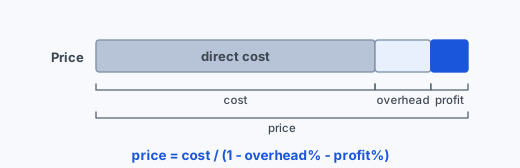
Overhead and profit are shares of the price, so they come off the top, not the bottom. If 14% of every dollar you collect goes to overhead and you want 10% left as profit, your job costs have to fit inside what is left of the price after those two shares. That leaves cost at 76% of the price, so the markup on cost is 24 divided by 76, or 31.6%.
That is why adding 14% and 10% to cost falls short. Adding percentages to cost is a markup. Taking them out of the price is a margin, and a margin of a given size always needs a bigger markup to reach it.
You don't need to do the conversion by hand. The markup vs margin calculator converts any margin to the markup that produces it, and the markup to margin chart lists common pairs side by side.
Worked example: a $600,000 year
Say last year your overhead lines came to 14% of gross receipts and you want a 10% profit. The overhead and profit calculator turns those two numbers into a price for any cost.
Here is $10,000 of materials priced with 14% overhead and 10% profit taken from the price.
| Line | Amount |
|---|---|
| Materials cost | $10,000.00 |
| Overhead, 14% of the price | $1,842.11 |
| Profit, 10% of the price | $1,315.79 |
| Selling price | $13,157.89 |
| Markup on cost | 31.6% |
| Price if you add 24% to cost instead | $12,400.00 |
| Shortfall from adding to cost | $757.89 |
Figures from the overhead and profit calculator.
Scale it to the whole year as a check. Job costs of $456,000 priced the same way bring in $600,000.00, with $84,000.00 recovered for overhead and $60,000.00 left as profit. The overhead share is 14% of the revenue, which is the figure you started from.
Add 24% to the same $456,000 instead and you bill $565,440.00. That is $34,560.00 short of covering the overhead and the profit you planned.
Ten and ten can mean 20, 21 or 25 percent
Ten and ten, meaning 10% overhead and 10% profit, is a common shorthand in construction pricing. The trouble is that people apply it in three different ways, and each one gives a different price. The glossary entry on overhead and profit works through the compounded reading line by line.
Here is $10,000 of cost under each reading.
| How ten and ten is applied | Price | Markup on cost | Margin on price |
|---|---|---|---|
| Add 10% and 10% to cost, 20% in all | $12,000.00 | 20% | 16.7% |
| Add 10% overhead, then 10% profit on top of that | $12,100.00 | 21% | 17.4% |
| Take 10% and 10% out of the price | $12,500.00 | 25% | 20% |
Figures from the markup vs margin and overhead and profit calculators.
Even the highest reading is short for the business in the worked example. Its books need $13,157.89 on the same $10,000 of cost, and ten and ten taken from the price gives $12,500.00.
So before you agree to ten and ten with a customer, an adjuster or a general contractor, ask which reading they mean. Then check it against your own overhead percentage, not against what is customary.
Materials, labor and subs don't need the same markup
Your target applies to the whole job, not to each line. You can mark up materials, labor and subs at different rates, as long as the job as a whole clears the margin your books need.
Take a worked example job. Materials of $6,800.00, labor of 120 hours at $46.00 an hour for $5,520.00, subs at $3,200.00, equipment at $900.00 and permits at $650.00 make $17,070.00 of direct cost. With 14% overhead and 10% profit taken from the price, the job cost calculator prices it at $22,460.53, a 24% gross margin.
Now say you price each line by its own markup and the total comes to $21,500.00. That is a 26% markup and a 20.6% margin, below the 24% the books need, even though no single line looked thin.
If customers resist a high markup on your labor, or can see the sub's bid, the materials line has to carry more. If some jobs are labor only, those jobs still need their share of overhead built into the labor rate. Build that rate with the labor cost calculator, which adds payroll taxes, workers comp, unemployment, liability and benefits to the base wage and spreads the total over the hours you can bill.
Check the markup on every finished job
A markup is a forecast. Overhead changes when you add a truck, rent a shop or hire office help, so recheck the percentage against your books at least once a year.
After each job, compare what you actually spent with what the estimate assumed. Keeping materials, labor and subs on separate lines of your contractor estimate makes that comparison quick, because each line on the estimate has a matching cost.
If finished jobs keep landing under the margin you need, the markup is too low, whatever the average in your trade is said to be.
Rules for sorting costs on Schedule C vary with your facts, so have a licensed tax professional confirm how your own lines are classified.
Overhead and profit calculator, Markup vs margin calculator, Job cost calculator, Markup to margin chart. Free, no signup, nothing to install.
Questions people ask
What is a typical markup on materials for contractors?
No figure fits everyone, because the markup has to cover your own overhead and profit. Work it out from your books. Overhead of 14% of revenue plus a 10% profit target needs a 31.6% markup on cost. Lower overhead needs less, and higher overhead needs more.
Should I mark up subcontractor bids?
Usually, because a sub's work still uses your overhead: scheduling, supervision, insurance and the warranty call. The markup on subs can be lower than on materials, as long as the whole job clears the margin you need.
Is ten and ten enough?
Only if your overhead really is close to 10% of revenue and 10% profit is your goal. Even then it depends on how it is applied. On $10,000 of cost it can mean $12,000.00, $12,100.00 or $12,500.00.
Do I mark up materials and labor by the same percent?
You don't have to. What matters is that the whole job reaches the margin you need. In the worked example, a job with $17,070.00 of direct cost needs $22,460.53 to reach a 24% margin, and pricing it at $21,500.00 gives only 20.6%.
What is the difference between markup and margin?
Markup is profit as a percent of cost. Margin is profit as a percent of the selling price. A 20% markup on $10,000 of cost gives a $12,000.00 price and a 16.7% margin.
How often should I recalculate my markup?
At least once a year, when you have a full year of numbers on your return, and any time overhead changes a lot, such as adding a truck, a shop or office help.
Sources
- IRS, 2025 Schedule C (Form 1040), Profit or Loss From Business, Line captions for Parts I, II and III used in the overhead map, including the cost of labor line that excludes amounts paid to yourself.
- IRS, 2025 Instructions for Schedule C (Form 1040), Contract labor, materials and supplies, wages that exclude amounts paid to yourself, and the small business choice not to keep an inventory.