Do You Have to Pay Estimated Taxes Your First Year in Business?
First year in business? No 2025 tax liability means no required 2026 estimates. Owed tax? See the safe harbor, the Jan. 15, 2027 date and a worked example.
Go straight to the quarterly estimated tax calculator Free, no signup. Read on if you want the detail first.The short answer: it depends on your 2025 return
You do not have to pay estimated tax in your first year in business if your 2025 return showed no tax liability, you were a US citizen or resident for all of 2025, and 2025 was a full 12-month tax year. If you did owe tax for 2025, you generally must pay in at least 100% of that 2025 tax during 2026, or 90% of your 2026 tax if that is smaller, spread over four due dates.
There is also a $1,000 test. Form 1040-ES says payments are required when you expect to owe at least $1,000 for 2026 after subtracting withholding and refundable credits, and your withholding and credits will fall short of the smaller of those two targets.
If your 2025 adjusted gross income was more than $150,000, or $75,000 if you file married filing separately for 2026, the 100% becomes 110%. Publication 505 walks all of these questions in one flowchart, Figure 2-A.
Notice what the rules do not ask: how long your business has been open. Being new does not exempt you. The test looks back at last year's tax, so your first year falls into one of two cases.
Case one: you owed no tax for 2025
Publication 505 says you had no tax liability for 2025 if your total tax was zero or you didn't have to file an income tax return. If all three conditions hold, no estimated payments are required for 2026, however much the new business earns.
Total tax is not your refund or your balance due. Publication 505 starts from total tax on your 2025 Form 1040, line 24, less a few uncommon items it lists. For example, if line 24 showed $3,000 and you had $3,500 withheld, you got a $500 refund but you still had a $3,000 liability. That puts you in case two.
Run the quarterly estimated tax calculator with $0 as last year's tax and it shows $0.00 for each payment, even with $6,782.18 of tax expected this year.
The exception removes the penalty, not the tax. Everything you owe for 2026 is still due with your 2026 return. On $48,000 of net profit, the self-employment part alone is $6,782.18, so set money aside as it comes in. The self-employment tax calculator shows that part for your own profit.
Case two: you had a paycheck and owed tax in 2025
If you worked a W-2 job in 2025 and owed tax, the safe harbor is built on that year's total tax. Say your 2025 total tax was $4,200 on $52,000 of adjusted gross income. The required annual payment is $4,200.00, which is $1,050.00 on each of the four dates.
That number holds even if the new business earns far more. The required payment is the smaller of 90% of this year's tax or 100% of last year's, so a big first year does not raise it. The rest of the 2026 tax is paid with the return.
Withholding counts toward the target. If you still work a job part time, the tax withheld comes off the required payment before any estimates. The Form 2210 instructions treat withholding as paid in equal parts on each due date, unless you choose to show the actual dates it was withheld.
Form 1040-ES also says that if you also receive wages, you may be able to avoid estimated payments by filing a new Form W-4 so your employer takes more tax out. Tax withheld in December still counts as one fourth paid on each date.
Worked example: $48,000 of profit in year one
Here is an example with made-up figures. You left a job in early 2026 and expect $48,000 of net profit from your own work. Your 2025 return showed $4,200 of total tax on $52,000 of adjusted gross income.
Self-employment tax alone on $48,000 of profit is $6,782.18. Even if that were your whole 2026 tax, 90% of it is $6,103.96, which is more than the $4,200.00 you owed for 2025. So the 2025 figure is the smaller one, and the required annual payment is $4,200.00.
The $1,000 test is met as well. With no withholding, the expected tax of $6,782.18 is over $1,000, so payments are required.
Required payments in the example, with no withholding and with $1,200 still withheld from a part-time job.
| Due date | No withholding | With $1,200 withheld |
|---|---|---|
| April 15, 2026 | $1,050.00 | $750.00 |
| June 15, 2026 | $1,050.00 | $750.00 |
| Sept. 15, 2026 | $1,050.00 | $750.00 |
| Jan. 15, 2027 | $1,050.00 | $750.00 |
| Total to pay in estimates | $4,200.00 | $3,000.00 |
From the quarterly estimated tax calculator: 2025 total tax $4,200, 2025 AGI $52,000, 2026 expected tax $6,782.18. The January payment can be skipped by filing early, as explained below.
Your real 2026 tax will usually be higher than $6,782.18, because income tax is added on top of self-employment tax. That does not change the required payment here, since the 2025 figure is still the smaller leg. It does change what you owe when you file: the balance above your payments comes due with the return.
With $1,200 withheld, the calculator takes it off first. That leaves $3,000.00 to pay in estimates, or $750.00 per date.
If your business started after March 31
You make your first payment by the due date for the period in which you first have income subject to estimated tax. Publication 505, Table 2-1, sets out the general dates.
Publication 505, Table 2-1, general due dates when no date falls on a weekend or holiday.
| First income arrives | First payment by | Later payments by |
|---|---|---|
| Before April 1 | April 15 | June 15, Sept. 15, Jan. 15 next year |
| April 1 to May 31 | June 15 | Sept. 15, Jan. 15 next year |
| June 1 to Aug. 31 | Sept. 15 | Jan. 15 next year |
| After Aug. 31 | Jan. 15 next year | None |
You can pay the whole estimate on the first date or spread it over the dates that remain.
Starting late does not shrink each installment by itself. Under the regular method each required installment is still one fourth of the required annual payment, so a June start leaves the April share unpaid. Form 1040-ES says that if a change after March 31, 2026 means you must start making payments, you should figure them with the annualized income installment method in chapter 2 of Publication 505.
The January 15, 2027 payment and filing early
The fourth payment for 2026 is due Friday, January 15, 2027. Form 1040-ES says you don't have to make it if you file your 2026 return by February 1, 2027, and pay the entire balance due with it.
Publication 505 states the rule as January 31, 2027, which is a Sunday. Form 1040-ES gives the next business day, Monday, February 1, 2027, so file and pay by then.
Filing early only covers the fourth installment. Publication 505 gives an example of someone who paid no estimates and filed and paid on January 26, 2027: the fourth payment counts as on time, but a penalty may still apply to the first three, figured up to January 26, 2027.
Filing early needs final numbers for the whole year. If a Form 1099 or a late invoice could still change your profit, send the January payment instead.
If you already missed a payment
The penalty is not a flat fine. Under section 6654 of the Internal Revenue Code and the Form 2210 instructions, it is figured on each underpayment for the number of days it stays unpaid, at the underpayment rate set under section 6621. Paying late costs less than not paying.
Payments are applied to the earliest unpaid installment first. A catch-up payment in October fills the April gap before it counts toward June or September.
In the $48,000 example, suppose you sent only $1,050.00 and three due dates have passed. Those dates called for $3,150.00, so you are behind by $2,100.00, and $3,150.00 is still to pay for the year. Send the shortfall now, since the charge keeps running by the day.
You don't have to work out the penalty yourself. Publication 505 says the IRS can generally figure it for you. Tax Topic 306 lists two waivers: a missed payment caused by a casualty, disaster or other unusual circumstance where the penalty would be inequitable, and retiring after reaching age 62 or becoming disabled in the tax year or the year before, when the underpayment was due to reasonable cause and not willful neglect.
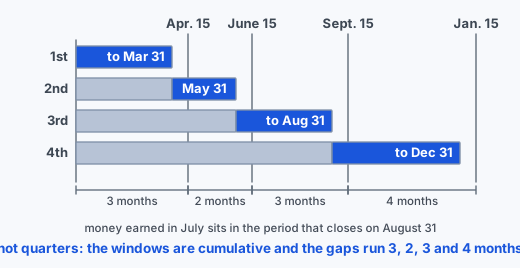
Seasonal or uneven income: Schedule AI
If most of your first-year income came late in the year, the annualized income installment method can lower the early installments. Publication 505's own example is a repair shop whose income is much larger in the summer.
The method measures income in cumulative periods: January 1 to March 31, January 1 to May 31, January 1 to August 31, and the full year. Each installment is based on what you actually earned through its period.
The Form 2210 instructions say that if you use the method for one due date, you must use it for all of them. Form 1040-ES adds that you file Form 2210 with Schedule AI with your 2026 return even if no penalty is owed. Publication 505 Worksheet 2-9 figures the 2026 amounts, since the quarterly calculator uses the regular method only.
How to make your first estimated tax payment
Form 1040-ES lists these ways to pay for 2026:
- Your IRS Online Account, which also shows the payments you have already made.
- IRS Direct Pay, an online transfer from a checking or savings account at no cost.
- EFTPS, online or by phone from a bank account. There is no fee, but you must be enrolled first.
- Debit card, credit card or digital wallet through a card service provider, which charges a fee.
- Check or money order payable to United States Treasury, mailed with that date's 2026 Form 1040-ES voucher. Write your Social Security number and 2026 Form 1040-ES on it, and don't send cash.
If you mail a payment and it is postmarked by the due date, the U.S. postmark date counts as the date of payment. Form 1040-ES adds that the postmark date is the date the item is processed at a postal facility, which may not be the day you drop it off, so mail early or pay electronically. State estimated tax, where your state has one, is separate and is not in any figure on this page.
Every deductible cost lowers the profit your estimate is built on. For business driving, the mileage deduction calculator figures it for 2026. Then build the tax into what you charge with the hourly rate calculator.
To get your own dates and amounts, enter last year's total tax, adjusted gross income and withholding into the quarterly estimated tax calculator.
Tax rules vary with your filing status, your state and the rest of your return, so have a licensed tax professional confirm the numbers for your own situation.
Quarterly estimated tax calculator, Self-employment tax calculator. Free, no signup, nothing to install.
Questions people ask
Do I have to pay estimated taxes my first year in business?
Only if you owed tax for 2025, expect to owe at least $1,000 for 2026 after withholding and refundable credits, and expect withholding and credits to fall short of the smaller of 90% of your 2026 tax or 100% of your 2025 tax. If your 2025 total tax was zero or you didn't have to file, you were a US citizen or resident all year, and 2025 was a full 12 months, no 2026 estimated payments are required.
What happens if I miss the January 15 estimated tax payment?
You can skip it by filing your 2026 return and paying the full balance by February 1, 2027. If you do neither, the penalty on that installment is figured by the number of days it stays unpaid, so paying soon keeps it small.
Is there an estimated tax penalty my first year if I owed no tax last year?
No, as long as all three conditions hold: no 2025 tax liability, US citizen or resident for all of 2025, and a 12-month 2025 tax year. You still owe the full 2026 tax when you file.
Does W-2 withholding count toward estimated tax?
Yes. Withholding is subtracted from the required payment and is treated as paid in equal parts on each due date unless you show the actual dates. In the example above, $1,200 of withholding drops each payment from $1,050.00 to $750.00.
Can I skip the fourth quarter payment by filing early?
Yes. File your 2026 return by February 1, 2027 and pay the whole balance, and the January 15, 2027 installment counts as paid on time. It does not cure earlier missed installments; any penalty on those is figured up to the date you file and pay.
How do I make my first estimated tax payment?
Pay through your IRS Online Account, IRS Direct Pay or EFTPS, by card through an approved processor for a fee, or mail a check or money order to United States Treasury with the 2026 Form 1040-ES voucher. EFTPS has no fee but needs enrollment first.
Sources
- IRS, Form 1040-ES (2026), Estimated Tax for Individuals, Who must pay, the $1,000 test, the 100% and 110% rules, the 2026 due dates, the February 1, 2027 filing option, the postmark rule and the ways to pay.
- IRS, Publication 505 (2026), Tax Withholding and Estimated Tax, The no tax liability definition, Figure 2-A, Table 2-1 start dates, the January payment example and the annualized method.
- IRS, Instructions for Form 2210 (2025), How the penalty runs by days, the order payments are applied, withholding timing and Schedule AI. The 2026 edition is not published yet.
- 26 U.S.C. 6654, Failure by individual to pay estimated income tax, The statute behind the required installments, the no liability exception and the waivers.
- IRS, Tax Topic 306, Penalty for underpayment of estimated tax, When the penalty applies and the two waivers.
- IRS, Schedule SE (Form 1040) 2026, The self-employment tax lines behind the $48,000 example.