Can I Deduct Mileage to and From Work as a Contractor?
Home to job is usually commuting, so no. A shop, a qualifying home office or an out of town temporary site changes that. Sort every trip here.
Open the free mileage deduction calculator Free, no signup. Read on if you want the detail first.The short answer: usually no
No, not usually. Driving from your home to your regular place of work is commuting, and the IRS says you can't deduct commuting no matter how far your home is from that place.
That holds for a 1099 contractor exactly as it does for an employee. Taking business calls on the drive does not change it. Carrying your tools does not change it either: Pub 463 says hauling tools in your own vehicle does not make the trip deductible. Only the extra cost of hauling them, such as renting a trailer you tow, is deductible.
Three situations change the answer. You drive from home to a temporary job site while you also have a regular place of work, such as a shop or yard. You drive from home to a temporary site outside the metro area where you live and normally work. Or your home is your principal place of business, so the trip from it to any job is a business trip.
Once you are at work, driving between work locations is business. Pub 463 counts getting from one workplace to another in the course of your business, and visiting customers. Job to job and job to an estimate visit are business miles in every setup.
The three exceptions in Rev. Rul. 99-7
The IRS set out the exceptions in Revenue Ruling 99-7, and Pub 463 and the Schedule C instructions repeat them. You can deduct daily trips between your home and a work location in these cases:
- Home to a temporary work location outside the metropolitan area where you live and normally work. This one does not require a regular place of work at all.
- Home to a temporary work location in any area, if you also have one or more regular work locations away from your home.
- Home to another work location in the same trade or business, regular or temporary, if your home is your principal place of business. Distance does not matter here.
Temporary has a precise meaning. A work location is temporary if your work there is realistically expected to last, and does in fact last, one year or less. If you expect the job to run more than a year, the site is not temporary from day one, whatever happens later.
Expectations can change partway through. Say a remodel was booked for eight months, and in month six the owner adds work that pushes it past a year. The ruling treats the site as temporary up to the date your expectation changed and not temporary after that date.
The ruling gives no mileage figure for a metropolitan area. If you have no regular place of work, Pub 463 says trips from home to temporary sites inside your metro area are generally commuting. So a contractor with no shop and no qualifying home office gets only the first exception.
Does your home office count as your principal place of business?
If you run the business from home, this exception turns on a strict test. Rev. Rul. 99-7 points to section 280A(c)(1)(A), the same home office rule explained in Pub 587.
Pub 587 lets a home office count as your principal place of business when you use it exclusively and regularly for administrative or management activities, and you have no other fixed location where you do substantial administrative or management work. The activities it lists include billing customers, keeping books and records, ordering supplies, setting up appointments and writing reports.
Exclusive means that specific area is used only for the business. Pub 587 says an area used for both business and personal purposes fails, and its example is a den the family also uses for recreation. Regular means steady use, and Pub 587 says incidental or occasional business use is not regular use.
Pub 587's own example is a self-employed plumber who spends most of the working day at customers' homes and writes up estimates on site. The plumber uses a small home office only for phoning customers, ordering supplies and keeping the books, and a bookkeeping service does the billing. That office qualifies as the principal place of business, because no other fixed location hosts substantial administrative work.
If you do substantial administrative work at a shop or office you rent, the home office fails the second part of the test. Then home to shop is a commute and shop to job is business, which is the middle column in the table below. Pub 587 says occasional minimal paperwork at another fixed location does not disqualify the home office, and neither does having another company do your billing.
A contractor's week, trip by trip
Here is how the common trips sort under the three setups contractors usually have. Each column changes only the setup and keeps every other fact the same.
| Trip | No shop, no qualifying home office | Shop or yard you report to | Home office is your principal place of business |
|---|---|---|---|
| Home to a 3 week remodel across town | Commuting | Deductible: temporary site and you have a regular one | Deductible |
| Home to a 4 month job outside your metro area | Deductible | Deductible | Deductible |
| Home to the shop or yard | Not applicable | Commuting | Deductible, if no substantial paperwork is done there |
| Shop or yard to a job site | Not applicable | Deductible | Deductible |
| Job to job, or job to an estimate visit | Deductible | Deductible | Deductible |
| Last job back home, temporary site in your metro area | Commuting | Deductible | Deductible |
| Home to a job expected to last more than a year | Commuting | Commuting | Deductible |
Based on Rev. Rul. 99-7 and Pub 463. A site is temporary only if the work is expected to last, and does last, one year or less.
A few more rules from Pub 463 catch contractors. Picking up your assignment at a union hall and driving from there to the job is commuting. Parking fees at your own place of business are commuting too, but parking fees when you visit a customer are deductible.
If you work at two places in one day, the trip between them is deductible. If you take a personal detour between them, you can deduct no more than it would have cost to drive straight from the first location to the second.
Pub 463 does not mention supply houses by name. Its closest example is for someone with no regular office and no office at home: the first business contact of the day counts as the office, so the drive from home to it is commuting, and so is the drive home from the last contact. The drives in between, from one customer to another, are deductible.
One day on the road, leg by leg
Here is a single day for a contractor with no shop and no qualifying home office: home to the supply house, on to a three week remodel, then to a second job, then home. Applying the Pub 463 rules above, the legs sort like this:
- Home to the supply house: commuting. It is the first business stop of the day, and Pub 463 treats the drive from home to the first business contact as commuting when you have no regular office and no home office.
- Supply house to the remodel: business. This is a drive between business stops during the working day, the kind Pub 463 lists as getting from one workplace to another in the course of your business.
- Remodel to the second job: business. Pub 463 says that if you work at two places in one day, the trip from one to the other is deductible.
- Second job to home: commuting. The drive home from the last business contact is commuting under the same Pub 463 example, because the second job is a temporary site inside your metro area.
Change the setup and the end legs change. With a shop you report to, the remodel and the second job are temporary sites while you have a regular work location, so the drive home from the second job becomes deductible under the second exception. With a home office that qualifies as your principal place of business, the drive home from the second job is deductible under the third exception, and so is the morning drive if it goes straight from home to a job.
In the log, write each leg on its own line with the stop it ended at, so the commuting legs and the business legs can be added up separately for Schedule C.
What the commuting rule costs you in dollars
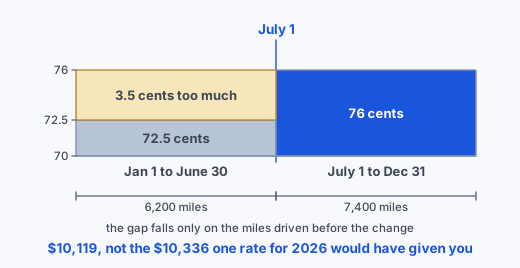
Take a worked example. A contractor with a shop drives 6,200 business miles from January through June 2026 and 7,400 from July through December. The 2026 rate is split: 72.5 cents a mile through June 30 and 76 cents from July 1, after the IRS raised it midyear because of increases in the price of fuel.
Now suppose a job booked for ten months is extended in July, and from then on the contractor expects it to run past a year. From that date the site is no longer temporary, so the daily drive from home to it is commuting. Say that moves 2,000 of the July to December miles out of the deduction. Run through the mileage deduction calculator at a 22% income tax bracket, the two versions of the year look like this.
Same contractor, same driving, one job reclassified.
| All 13,600 miles are business | 2,000 later miles become commuting | |
|---|---|---|
| January to June miles | 6,200 | 6,200 |
| July to December miles | 7,400 | 5,400 |
| January to June deduction, at 72.5 cents | $4,495.00 | $4,495.00 |
| July to December deduction, at 76 cents | $5,624.00 | $4,104.00 |
| Total deduction | $10,119.00 | $8,599.00 |
| Rough tax saved | $3,498.67 | $2,973.13 |
Tax saved combines self-employment tax and income tax at 22%. Self-employment tax is $1,429.77 of the first figure and $1,215.00 of the second.
The 2,000 lost miles alone are worth $1,520.00 of deduction at the 76 cent rate, which the calculator puts at roughly $525.54 of tax, $214.77 of it self-employment tax.
Change one fact and the miles come back. If the same contractor had no shop and a home office that qualifies as the principal place of business, the third exception covers trips to regular and temporary locations alike, and the deduction stays $10,119.00.
The split rate matters too. Using one rate for all 13,600 miles would give $10,336.00, which is $217.00 too much. Each half of the year needs its own rate.
Keep a log that would survive an audit
Vehicle expenses carry their own proof rule. Section 274(d) of the tax code bars a deduction for listed property unless you substantiate it with adequate records or sufficient evidence corroborating your own statement. The Schedule C instructions say listed property includes passenger cars weighing 6,000 pounds or less and other transportation property, such as pickup trucks.
Pub 463 asks you to record each business use at or near the time: the date, the destination, the business purpose and the miles. Add the total miles for the year and the date you started using the vehicle for business. An account book, a diary, a log or trip sheets all count, and Pub 463 includes a sample daily mileage log with odometer start and stop columns.
For a contractor the business purpose is usually the job name or address. One simple habit is to write the miles on the same page as the day's work, such as a construction daily log template, so the trip and the job sit together.
Schedule C Part IV asks for business, commuting and other miles on lines 44a to 44c, then asks on lines 47a and 47b whether you have evidence and whether it is written. Pub 463 says to keep the records generally for 3 years from the date you file the return.
Standard rate or actual expenses
The standard mileage rate keeps the paperwork down to the log. You have to choose it in the first year the vehicle is available for business use. If you lease the vehicle and choose it, you must use it for the entire lease period.
With the standard rate you still add business parking fees and tolls. You do not also deduct depreciation, rent or lease payments, or actual operating costs such as gas and repairs. The line 9 instructions also say you cannot use the standard rate if you operate five or more vehicles at the same time.
Miles lower both your income tax and your self-employment tax, which is why the $3,498.67 in the example includes $1,429.77 of self-employment tax. To see what your miles do to the full bill, run your net profit through the self-employment tax calculator, then set your next payment with the quarterly estimated tax calculator.
Tax rules vary with your facts, so have a licensed tax professional confirm how your own trips should be treated before you file.
Mileage deduction calculator, Self-employment tax calculator, Quarterly estimated tax calculator. Free, no signup, nothing to install.
Questions people ask
Can a 1099 contractor deduct mileage from home to a job site?
Only in three cases: the site is temporary and outside your metro area, the site is temporary and you also have a regular place of work such as a shop, or your home office is your principal place of business. Otherwise the drive from home is commuting, the same as for an employee.
Does carrying tools in my truck make the drive deductible?
No. Pub 463 says hauling tools or instruments in your vehicle while commuting does not make the trip deductible. You can deduct only the additional cost of hauling them, such as renting a trailer you tow.
How long can a job last and still count as temporary?
One year or less, both as you realistically expected and as it actually ran. A job you expect to last more than a year is not temporary, even if it ends sooner. If your expectation changes partway through, the site is temporary until the date it changed.
I do estimates and billing from my home office. Are my drives to jobs deductible?
They can be, if the office passes the Pub 587 test: used exclusively and regularly for administrative or management work, with no other fixed location where you do substantial amounts of that work. Then trips from home to any job in the same business count, however far.
What is the 2026 business mileage rate?
72.5 cents a mile for business driving costs paid or incurred January 1 through June 30, 2026, and 76 cents for those paid or incurred on or after July 1, 2026. The IRS raised it midyear in Announcement 2026-11, which says the change results from recent increases in the price of fuel.
Can I deduct gas and repairs on top of the standard mileage rate?
No. The Schedule C line 9 instructions say that with the standard mileage rate you do not deduct depreciation, rent or lease payments, or actual operating expenses. Business parking fees and tolls are the extras you can add.
What records do I need for business mileage?
A record made at or near the time of each trip showing the date, the destination, the business purpose and the miles, plus your total miles for the year and the date the vehicle went into business use. Generally, keep it for 3 years from the date you file the return.
Sources
- IRS Publication 463, Travel, Gift, and Car Expenses, Commuting, hauling tools, union hall, parking, two places of work, temporary work locations, recordkeeping and the standard mileage rate rules.
- IRS Revenue Ruling 99-7, The three exceptions to the commuting rule and the one year test for a temporary work location.
- IRS Publication 587, Business Use of Your Home, When a home office qualifies as the principal place of business through administrative or management activities.
- IRS news release IR-2025-128, The 72.5 cent business rate from January 1, 2026 and the first year choice of the standard rate.
- Internal Revenue Bulletin 2026-29, Announcement 2026-11, The 76 cent business rate for costs paid or incurred on or after July 1, 2026.
- IRS Instructions for Schedule C (Form 1040), 2025, Line 9 standard rate rules, listed property, and the Part IV commuting definition and recordkeeping questions.
- 26 U.S.C. 274(d), substantiation requirements, No deduction for listed property expenses without adequate records or sufficient corroborating evidence.