Can a contractor put a lien on my house without a contract?
Often, yes. Lien rights follow work you asked for, written or not. Texas homesteads and Arizona owner-occupied homes need a written contract.
Go straight to lien deadlines by state Free, no signup. Read on if you want the detail first.The short answer
Often, yes. A contractor can usually put a lien on your house for work you asked for even if nothing was signed, because lien statutes tie the right to the work done at your request, not to a written contract.
The big exceptions protect the home you live in. Texas will not fix a lien on a homestead without a written contract signed before the work started and filed with the county clerk. Arizona allows no lien on an owner-occupant's dwelling except by a person who signed a written contract directly with the owner-occupant.
This guide reads the statutes of four states: Texas, Arizona, Minnesota and Washington. If your house is somewhere else, the mechanics lien deadlines by state chart is the place to start, and your own state's statute is the final word.
What the lien statutes say about a contract
Each of the four statutes ties the lien to who asked for the work, and none of the basic lien sections requires the contract to be written. The table answers four questions for each state: whether a lien can rest on an unwritten contract, what changes for your home, what happens if the contractor was unlicensed, and which notice you should see before a lien.
Four questions, four states, read from the statute text. The full statutes are listed under Sources.
| State | Lien without a written contract? | Your home | Unlicensed contractor | Notice you should see first |
|---|---|---|---|---|
| Texas | Yes in general: work under a contract with the owner, the owner's agent, a contractor or a subcontractor (Prop. Code 53.021) | Homestead: a written contract signed before work starts, by both spouses if married, and filed with the county clerk (53.254) | 53.021 names a license only for architects, engineers and surveyors | From a sub or supplier, a notice of claim by the 15th of the second month after each month of work (53.056); none from your own contractor |
| Arizona | Yes in general: work at the instance of the owner or the owner's agent (A.R.S. 33-981(A)) | Owner-occupied dwelling: no lien except by a person who signed a written contract directly with you (33-1002(B)) | No lien rights without a required license (33-981(C)); no suit to collect without proof of license (32-1153) | A preliminary twenty day notice from every claimant except a wage laborer, within 20 days after first furnishing to the jobsite (33-992.01) |
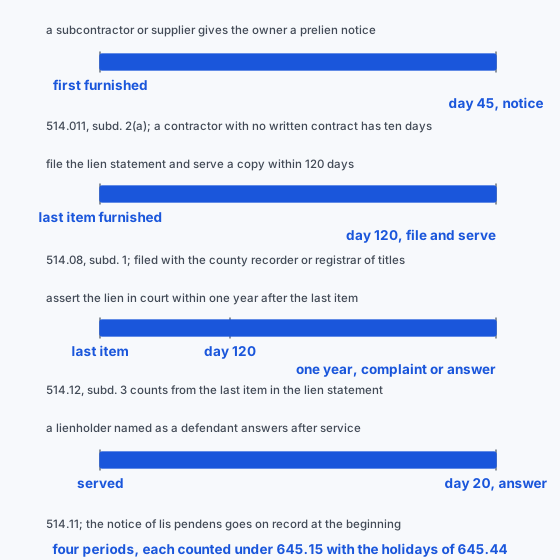
| Minnesota | Yes: work under contract with the owner or at the instance of the owner's agent, contractor or subcontractor (Stat. 514.01) | A contractor who will use subs or suppliers must give you a lien notice, in the written contract or, with none, separately within 10 days (514.011, subd. 1) | Not addressed in 514.01 or 514.011 | Your contractor's notice (subd. 1), and a notice from each sub or supplier within 45 days after it first furnishes (subd. 2) |
| Washington | Yes in general: work furnished at the instance of the owner or the owner's agent (RCW 60.04.021) | Owner-occupied remodel: a direct contractor needs no notice; others are paid only from what you still owed your prime contractor (60.04.031(3)) | No court action to collect without alleging and proving registration (RCW 18.27.080) | A notice of right to claim a lien from a supplier you did not contract with (60.04.031(3)(b)) |
Each cell is a summary. Read the section itself before you act on it.
Texas: a homestead lien needs a written contract signed first
Texas Property Code section 53.254 sets the conditions for a lien on a homestead. The person who furnishes the material or labor and the owner must sign a written contract that sets out the terms. It must be signed before any material is furnished or labor is performed. If the owner is married, both spouses sign. The contract must be filed with the county clerk of the county where the homestead is located.
So if a contractor worked on your Texas homestead on a handshake, the statute's conditions for fixing a lien on that homestead were never met. A contract signed after the work started does not meet them either, because subsection (b) requires it to come first.
One detail cuts the other way. When the original contractor signs a proper homestead contract with you, subsection (d) says it inures to the benefit of everyone who labors or furnishes material for that contractor. Your subs and suppliers can rely on the contract you signed with your contractor.
Any lien affidavit against a homestead must carry this notice at the top of the page, in at least 10 point bold: "NOTICE: THIS IS NOT A LIEN. THIS IS ONLY AN AFFIDAVIT CLAIMING A LIEN." An affidavit against your homestead without that notice does not meet subsection (f).
Arizona: no lien on your home unless you signed with that person
A.R.S. 33-1002(B) says no lien is allowed or recorded against the dwelling of an owner-occupant except by a person who signed a written contract directly with the owner-occupant. Subsection (C) makes any waiver of that protection void, so you cannot sign it away.
A dwelling is a one-family or two-family home, including a condominium unit. You are an owner-occupant if you are a natural person who, before the work began, held title by a deed or contract recorded with the county recorder, and you live or intend to live there at least 30 days in the 12 months after the work is completed, and do not intend to sell or lease it to others.
That shuts out two groups. A contractor you hired on a handshake has no lien on your home, and neither does a subcontractor or supplier who signed with your contractor rather than with you. The Arizona lien deadline calculator gives the same answer: set it to an owner-occupied home where the claimant did not sign with the owner, and it returns no lien available under 33-1002(B).
Section 33-1002 removes the lien. It does not say the money stops being owed.
Minnesota: no written contract means a separate notice within 10 days
Minnesota section 514.01 gives a lien for work done under contract with the owner or at the instance of the owner's agent, contractor or subcontractor. It does not require that contract to be written. What Minnesota adds is a notice.
Under section 514.011, subdivision 1, a contractor who contracts with you and has or will have subcontractors or suppliers must put a lien notice in the written contract. If there is no written contract, the notice must be prepared separately and delivered to you personally or by certified mail within ten days after the work is agreed upon. A contractor who fails to provide the notice does not have the lien. The statute lists exceptions, such as a contractor tied to the owner through officers or common management.
The notice tells you that unpaid suppliers and subs may file a lien against your property. It also tells you that you may pay them directly and deduct that from the contract price, or withhold what is due them until 120 days after completion unless you get their lien waivers.
As an example, say you and a Minnesota contractor agreed on a job on November 2, 2026, with no written contract. The Minnesota lien deadline calculator puts the last day to deliver that notice at November 12, 2026.
Washington: a direct contractor on your remodel has a lien without notice
Washington gives a lien for labor, materials or equipment furnished at the instance of the owner or the owner's agent (RCW 60.04.021). That section does not require a written contract.
On a repair, alteration or remodel of an existing owner-occupied single-family home or its garage, RCW 60.04.031(3)(a) says a person who furnishes professional services, materials or equipment and contracts directly with you does not have to send a notice of the right to claim a lien. That person has a lien for the full amount due under the contract.
If the contractor was not licensed
In Arizona, a person who is required to hold a contractor license and does not hold a valid one has no lien rights under section 33-981(C). Section 32-1153 adds that a contractor cannot sue to collect payment for licensed work without alleging and proving it was licensed when the contract was made and when the claim arose.
Washington works through registration instead. RCW 18.27.080 says a contractor cannot bring or maintain a court action to collect for work that needs registration without alleging and proving it held a current and valid registration when it contracted for the work. In Texas, the lien section, 53.021, mentions a license only for architects, engineers and surveyors. Minnesota's 514.01 and 514.011 do not address licensing, so check the state's licensing law and board records if you think your contractor was unlicensed.
Subcontractors and suppliers you never hired
A sub or supplier who never dealt with you can still have lien rights in some states. They usually have to warn you first, and paying your contractor protects you in different ways depending on the state.
- Texas: a sub or supplier sends a notice of claim to you and the original contractor. On a residential project it is due by the 15th day of the second month after the month the work or material was provided (53.056). You must reserve 10% of the contract price, or of the value of the work, while the work goes on and for 30 days after completion (53.101). Apart from a failure to reserve, you are not liable for amounts paid to the original contractor before you were authorized to withhold (53.084).
- Arizona: on an owner-occupant's dwelling, a sub or supplier who did not sign a written contract directly with you has no lien (33-1002(B)). Elsewhere, every claimant except a wage laborer must serve you a preliminary twenty day notice for its lien to be valid (33-992.01(B)).
- Minnesota: a sub or supplier must give you written notice within 45 days after it first furnished labor, skill or materials (514.011, subd. 2). The required notice says: "We may not file a lien if you paid your contractor in full before receiving this notice."
- Washington: on a remodel of your owner-occupied single-family home, a person furnishing professional services, materials or equipment who did not contract with you must give you notice, and its lien can only be satisfied from amounts you had not yet paid the prime contractor when you received that notice (60.04.031(3)(b)). The statutory notice form also warns that laborers on your project may claim a lien without sending you a notice.
The preliminary notice deadlines by state chart lists the notice rules in other states.
How you would find out about a lien
In Texas, a claimant must send you a copy of the lien affidavit within 5 days after filing it with the county clerk (53.055). The clerk indexes and cross-indexes the affidavit under the names of the claimant, the original contractor and the owner, so it can be found under your name in the county records (53.052(e)). A clerk's mistake in indexing does not invalidate the lien, so a clean search is not proof that nothing was filed.
In Minnesota and Washington, and in Arizona outside an owner-occupied dwelling, a warning can come earlier, as one of the notices described above. In Arizona, start with your own paperwork: if you never signed a written contract with the claimant and you are an owner-occupant, 33-1002(B) applies.
Worked example: a Texas homestead remodel finished in November 2026
This is an example, not a real case. Say a contractor finished a remodel on your Texas homestead in November 2026 and says it was not paid. A subcontractor on the same job last worked there in November 2026. Here are the dates the Texas lien deadline calculator returns for a residential project.
Texas residential project, work last done in November 2026.
| Step | Original contractor | Subcontractor |
|---|---|---|
| Notice of claim to you and the original contractor | Not required | January 15, 2027 |
| Lien affidavit filed with the county clerk | February 15, 2027 | February 15, 2027 |
| Copy of the affidavit sent to you | Within 5 days of filing | Within 5 days of filing |
| Suit to foreclose the lien | February 15, 2028 | February 15, 2028 |
Sections 53.056, 53.052, 53.055 and 53.158. Each month a sub works carries its own notice deadline.
On a homestead, neither claimant can fix a lien unless the written contract in section 53.254 was signed before the work began, by both spouses if you are married, and filed with the county clerk.
If the original contractor did have that contract, the sub's notice to you must include the homestead statement in 53.254(g). It tells you about the 10% reservation, and that apart from it you are not liable to a sub or supplier for amounts paid to your contractor before you received written notice of the claim.
What happens after a lien is filed
A filed lien is a claim the claimant still has to enforce in court. In Texas, suit to foreclose must be brought by the first anniversary of the last day the claimant could have filed the affidavit (53.158(a)). That runs from the filing deadline, not from the day it actually filed. In the example above, it is February 15, 2028.
The period can be extended to the second anniversary of the filing date only by a written agreement with the record owner made before the first period runs out (53.158(a-2)). Once the deadline has passed, a later suit to discharge the lien does not revive the claimant's right to foreclose (53.158(a-1)).
Where to read your own state's rule
The statutes behind this guide are listed under Sources below. For Washington dates, use the Washington lien deadline calculator. If you are the one doing the work, our guide on whether contractors need a written contract covers the contractor side.
Lien rules vary by state and change over time, so have a licensed attorney in your state confirm your specific situation.
Mechanics lien deadlines by state, Texas lien deadline calculator, Arizona lien deadline calculator, Preliminary notice deadlines by state. Free, no signup, nothing to install.
Questions people ask
Can a contractor file a lien without a written contract?
In many cases, yes. Texas, Arizona, Minnesota and Washington tie the lien to work done at the owner's request or under a contract with the owner, and their basic lien sections do not require writing. Texas homesteads and Arizona owner-occupied homes are the exceptions: both need a written contract with the owner. In Minnesota, a contractor with no written contract who will use subs or suppliers must deliver a separate lien notice within 10 days after the work is agreed upon.
Can a contractor put a lien on my house without me knowing?
You can miss one, which is why the notice rules matter. In Texas a claimant must send you a copy of the affidavit within 5 days of filing it, and the county clerk indexes it under your name as owner. Arizona, Minnesota and Washington require notices to the owner before some liens. If you suspect a filing, search your county's property records.
Can a subcontractor put a lien on my house if I paid the contractor?
It depends on the state. In Texas you are not liable for amounts paid to the original contractor before you could withhold, except for the 10% you had to reserve until 30 days after completion. In Minnesota the required notice says the claimant may not file a lien if you paid your contractor in full before receiving it. In Washington, a remodel supplier who did not contract with you can only be paid from amounts you had not yet paid the prime contractor. In Arizona, on an owner-occupied home, a sub who did not sign with you has no lien.
Can an unlicensed contractor put a lien on my house?
Not in Arizona. Section 33-981(C) says a person required to be licensed who does not hold a valid license has no lien rights, and section 32-1153 blocks a suit to collect without proof of a license. In Washington, RCW 18.27.080 bars a court action to collect without proof of a current registration. Other states have their own rules, so check yours.
How long does a contractor have to file a lien?
It depends on the state and the project. In Texas, an original contractor on a residential project files by the 15th day of the third month after the month the work was completed, terminated or abandoned. For work finished in November 2026, that is February 15, 2027.
What happens after a lien is filed?
The claimant has to enforce it in court within a deadline. In Texas, suit to foreclose must be brought by the first anniversary of the last day the affidavit could have been filed, unless a written agreement with the record owner extends it. Once that deadline passes, a later suit to discharge the lien does not revive the right to foreclose.
Sources
- Texas Property Code, Chapter 53, Mechanic's, Contractor's, or Materialman's Lien, Sections 53.021, 53.052, 53.055, 53.056, 53.084, 53.101, 53.158 and the homestead rules in 53.254.
- Arizona Revised Statutes 33-1002, Definitions; inapplicability of certain liens to owner-occupied dwelling; waiver void, Definitions of dwelling and owner-occupant, the written contract rule in (B), and the void waiver in (C).
- Arizona Revised Statutes 33-981, Lien for labor; professional services or materials used in construction, alteration or repair of structures, Lien for work at the instance of the owner, and no lien rights for an unlicensed person in (C).
- Arizona Revised Statutes 33-992.01, Preliminary twenty day notice, Every claimant except a person performing actual labor for wages serves the owner within 20 days after first furnishing, in (B) and (C).
- Arizona Revised Statutes 32-1153, Proof of license as prerequisite to civil action, A contractor must allege and prove it was licensed to sue for compensation.
- Minnesota Statutes 514.01, Mechanics, laborers and material suppliers, Lien under contract with the owner or at the instance of a contractor or subcontractor.
- Minnesota Statutes 514.011, Notice, The 10 day notice with no written contract in subd. 1, and the 45 day subcontractor notice in subd. 2.
- Revised Code of Washington 60.04.021, Lien authorized, Lien for labor, materials or equipment furnished at the instance of the owner.
- Revised Code of Washington 60.04.031, Notices, exceptions, No notice for a direct contractor on an owner-occupied remodel in (3)(a), and the limit on other claimants in (3)(b).
- Revised Code of Washington 18.27.080, Registration prerequisite to suit, An unregistered contractor cannot sue to collect for work that needs registration.