What Size Generator to Run a Well Pump and Furnace
Size one generator for a well pump, gas furnace and fridge: the starting watt formula, a 240 volt pump, and why some furnaces will not run on a generator.
Open the free generator size calculator Free, no signup. Read on if you want the detail first.The answer in one formula
To run a 1 HP two-wire well pump, a gas furnace, a fridge and some lights from one generator, the worked example below needs 8,600 starting watts. A smaller pump brings that down, and a bigger one pushes it up fast.
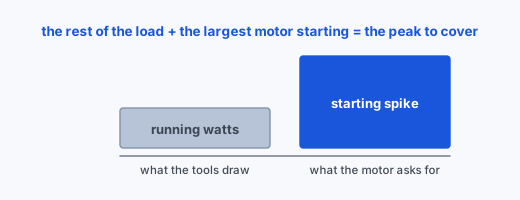
The rule behind it: add the running watts of everything that will be on, take out the running watts of the biggest motor, and add that motor back at its starting multiple. Compare the result with your running watts plus 20 percent headroom, and buy the larger figure.
The generator size calculator offers three starting multiples: 2x for an inverter or ECM motor, 3x for a standard induction motor and 4x for a well pump or AC compressor. It assumes the big motor starts while everything else is already running, which is the hardest moment the generator will face.
What each load actually draws
Use nameplate figures, not a generic chart. A rating plate lists watts, or amps and volts that you multiply together for a working watt figure.
For the pump, use the motor maker's data. Franklin Electric's SubData manual lists these maximum load watts for its 4 inch, 230 volt submersible motors:
- 1/2 HP two-wire: 1,000 W
- 3/4 HP two-wire: 1,350 W
- 1 HP two-wire: 1,630 W
- 1.5 HP two-wire: 2,170 W
- 1 HP three-wire, standard control box: 1,460 W
- 2 HP three-wire, standard control box: 2,535 W
For the furnace, read its rating plate. Carrier's installation instructions for its 58TUA gas furnace list maximum unit amps at 115 volts from 8.2 A to 18.2 A, and the figure does not follow furnace size: the smallest model, the 040-12, lists 11.4 A, while the 060-08 lists 8.2 A. Read the plate on your own furnace rather than guessing from its size.
Fridges, freezers, lights and chargers carry their own labels. List only what you will actually run during the outage, because every extra load raises the running total and the peak with it.
Worked example: pump, furnace, fridge and lights
This is an example, not a measured house. The pump figure is Franklin's. The other three are round example numbers to show the method, so swap in your own nameplates.
| Load | Running watts | Where the figure comes from |
|---|---|---|
| 1 HP two-wire well pump, 230 V | 1,630 W | Franklin max load |
| Furnace blower and controls | 800 W | Example figure |
| Refrigerator | 700 W | Example figure |
| Lights and phone chargers | 500 W | Example figure |
| Total running watts | 3,630 W | Generator calculator |
Pump entered as the largest motor at 4x, with 20 percent reserve and a 240 volt supply.
- Pump starting surge: 6,520 W
- Peak starting watts, with everything else running: 8,520 W
- Running watts with 20 percent reserve: 4,356 W
- Generator to buy: 8,600 starting watts
- Load at 240 volts: 18.2 A, so a 20 A inlet and transfer switch
The peak, not the running load, sets the size. The running load with reserve is only 4,356 W, but the pump's start lifts the peak to 8,520 W.
Swap in your own figures and the answer moves. Carrier's lowest listed figure, 8.2 A, is 943 W at 115 volts, more than this example's 800 W. Enter 943 W for the furnace and the same list needs 8,700 starting watts. With the 800 W furnace and a 3/4 HP two-wire pump in place of the 1 HP, the list needs 7,400 starting watts. With a 1 HP three-wire pump it needs 7,900. Run your own list through the generator size calculator before you shop.
The well pump decides the size
Franklin Electric says a generator must hold at least 65 percent of the motor's nameplate voltage while the motor starts. Below that, the motor does not get enough torque to start.
Franklin also publishes a minimum generator rating for each motor size. Here it is next to what the calculator gives for the pump on its own:
| Franklin 4 in motor, 230 V | Max load watts | Calculator, pump alone | Franklin minimum generator |
|---|---|---|---|
| 1/2 HP two-wire | 1,000 W | 4,000 W | 3 kW |
| 3/4 HP two-wire | 1,350 W | 5,400 W | 4.5 kW |
| 1 HP two-wire | 1,630 W | 6,600 W | 6 kW |
| 1.5 HP two-wire | 2,170 W | 8,700 W | 7.5 kW |
| 1 HP three-wire | 1,460 W | 5,900 W | 4 kW |
| 1.5 HP three-wire | 1,980 W | 8,000 W | 5 kW |
| 2 HP three-wire | 2,535 W | 10,200 W | 7.5 kW |
Calculator column: starting watts at 4x with 20 percent reserve and nothing else running. Franklin column: minimum rating for an externally regulated generator, which Franklin says applies to two-wire, three-wire and three-phase motors.
Two-wire pumps need more generator. Franklin lists 6 kW for a 1 HP two-wire motor and 4 kW for a 1 HP three-wire one. A three-wire pump works with a separate control box. A two-wire pump has none.
Franklin states its figure as a generator rating in kW and kVA, not as a surge. Check that your generator's rated output meets it, and do not lean on the starting watt figure alone.
Do not add a soft starter or other voltage reduction to a pump on a generator. Franklin says a generator sized to its minimum rating already acts as a soft start for the motor, and that no additional voltage reduction is allowed.
Start the generator before you turn the pump on, and turn the pump off before you shut the generator down. Franklin warns that if the generator coasts down or runs out of fuel with the pump running, the motor's thrust bearing can be damaged.
Franklin also notes that a pump running 1 to 2 Hz below its nameplate frequency will not meet its performance curve, and 1 to 2 Hz above it may trip the overloads. Follow the generator maker's derating at high elevation or on natural gas.
Why a gas furnace may not run on a portable generator
A modern gas furnace can refuse to heat on generator power even when the wattage is fine. Carrier's 58TUA instructions say the control system needs an earth ground to work, and that the 115 volt supply must keep correct polarity. With polarity reversed, the status light flashes rapidly and the furnace will not heat.
Generac's help center explains that most open frame generators have a bonded neutral, tied to the frame, while most inverter generators have a floating neutral. A device that needs the ground pin will not work if that pin is not functional on a floating neutral generator.
Generac names its own GP8000E open frame model as bonded and its GP3300i inverter as floating, and tells owners to check the owner's manual to learn which type their unit is.
When a generator feeds a building through a transfer switch, OSHA's grounding fact sheet says it must be connected to a grounding electrode system, such as a driven ground rod. Ask the electrician who installs your switch how your generator's neutral should be handled with it.
240 volts, inlet boxes and transfer switches
In Franklin's 4 inch single-phase tables, every motor from 3/4 HP up is listed at 230 volts only. So you need a generator with a 240 volt outlet, and a safe way to feed the pump's 240 volt circuit.
Hire a licensed electrician for that connection, and have them confirm the generator size against your actual nameplates. OSHA says never to attach a generator to a building's electrical system unless a qualified electrician has installed it with a transfer switch, and that the switch must be approved for the use and installed to the maker's instructions.
Size the inlet and switch from the calculator's amps line. The worked example draws 18.2 A at 240 volts with reserve, so the calculator picks a 20 A inlet and switch.
Check the cord against the wire size chart, and run the voltage drop calculator on long runs. Voltage lost in a long cord comes off what reaches the pump, and Franklin wants at least 65 percent of nameplate voltage while the motor starts. CPSC adds that a cord must be heavy duty, made for outdoor use, and rated above the total wattage of everything on it.
Fuel for a winter outage
The calculator figures burn as if every load on the list ran for the whole hour. For the worked example's 3,630 running watts:
| Fuel | Burn per hour | Runtime on 5 gal | Fuel for 24 hours |
|---|---|---|---|
| Gasoline | 1.04 gal | 4.8 hours | 25 gal |
| Propane | 1.4 gal | 3.6 hours | 34 gal |
| Diesel | 0.81 gal | 6.2 hours | 20 gal |
Calculator assumptions: 3.5 kWh from a gallon of gasoline, 2.6 from propane and 4.5 from diesel. Your generator's own runtime chart beats these estimates.
At this load a 5 gallon gasoline tank runs out in under 5 hours, so a long night means at least one refill. OSHA says to shut the generator down and let it cool before refueling. Turn the pump off first, per Franklin's rule above.
OSHA also says not to store generator fuel in your home. Keep it in approved, vented containers marked for their contents, away from living areas and away from the generator itself.
Backfeed and carbon monoxide
Never power the house by plugging the generator into a wall outlet. CPSC calls this backfeeding: it puts utility workers and neighbors served by the same transformer at risk of electrocution, and it bypasses some of your home's circuit protection. OSHA adds that an improper connection can energize wiring for great distances.
Run the generator outside only, at least 20 feet from the house, as CPSC said in its February 2026 winter storm warning. Never run it in the home, garage, basement, crawlspace or shed. OSHA warns that open windows and doors may not prevent carbon monoxide from building up, and wants 3 to 4 feet of clear space on all sides and above the unit.
CPSC puts the toll at an average of nearly 100 deaths a year in the U.S. from carbon monoxide made by portable generators. Install battery-operated CO alarms, or plug-in alarms with battery backup, certified to UL 2034 or another listed standard, and test the batteries monthly.
Generator size calculator, Wire size chart, Voltage drop calculator. Free, no signup, nothing to install.
Questions people ask
Will a 7,500 watt generator run a well pump and a furnace?
Only with a smaller pump, and only if 7,500 is its starting rating. With the example furnace, fridge and lights, the calculator gives 7,400 starting watts with a 3/4 HP two-wire pump, 7,900 with a 1 HP three-wire pump and 8,600 with a 1 HP two-wire pump. Then check the generator's rated output against Franklin's minimum for your motor.
How many watts does a furnace blower use?
Read your furnace's rating plate. If it lists amps, multiply by 115 volts for a working watt figure. Carrier's 58TUA instructions list maximum unit amps from 8.2 A to 18.2 A at 115 volts, depending on the model. The 800 W in this article's worked example is an example, not a typical value.
Can a portable generator run a 240 volt well pump?
Yes, if it has a 240 volt outlet, enough capacity for the pump's start and a proper connection. Franklin's minimum generator for a 1 HP two-wire motor is 6 kW. The connection to house wiring needs a transfer switch installed by a qualified electrician, per OSHA.
Why won't my gas furnace run on my generator?
Check ground and polarity first. Carrier's furnace control needs an earth ground and correct polarity, and with polarity reversed it flashes its status light rapidly and will not heat. Generac says most inverter generators have a floating neutral, and a device that needs the ground pin will not work if that pin is not functional.
Do I need a transfer switch to run my furnace on a generator?
Yes, if the generator will feed the furnace through your house wiring. OSHA says never to attach a generator directly to a building's electrical system unless a qualified electrician has installed it with a transfer switch. Plugging into a wall outlet instead is backfeeding, which CPSC warns can electrocute utility workers.
How much fuel does a generator use overnight?
At the worked example's 3,630 running watts, the calculator estimates 1.04 gallons of gasoline an hour, 4.8 hours on a 5 gallon tank and 25 gallons for a full day. Propane runs higher at 1.4 gallons an hour. Check your generator's own runtime chart.
Sources
- Franklin Electric, SubData Manual M1312 (60 Hz), 2024, engine driven generators, generator minimum rating table and 4 inch motor specifications
- Carrier Corporation, 58TUA Installation, Start-Up, and Operating Instructions (Form 58TUA-7SI), earth ground and polarity requirements, Table 5 electrical data
- Generac Help Center, Does my portable generator have a bonded or floating neutral?
- OSHA Fact Sheet, Using Portable Generators Safely (FS-3286), transfer switch, carbon monoxide and refueling rules
- OSHA Fact Sheet, Grounding Requirements for Portable Generators
- CPSC Safety Alert, Portable Generator Hazards (Publication 5123), backfeeding, cords and CO alarms
- CPSC, Winter Storm May Knock Out Power; CPSC Warns of Deadly Carbon Monoxide and Fire Risks (February 19, 2026), 20 foot distance and annual death toll