What Is a Normal Change Order Markup Percentage?
There is no one normal change order markup. Your contract's changes clause sets it. See four published contract rates side by side and a worked $4,000 change.
Open the free overhead and profit calculator Free, no signup. Read on if you want the detail first.Short answer: your contract sets the markup
There is no single normal change order markup. The number that counts is the one in your contract's changes clause, and in the four published public contracts below the stated rates run from 5 percent of a subcontractor's invoice to 25 percent on your own labor and materials, with one of them leaving overhead to negotiation.
If your contract names no rate for changes, none of these clauses applies to you, and the markup is simply part of the change order price you and the owner sign. Price it like any other work: your real overhead plus the profit you want. If the contract does have a changes clause with a rate, that rate is the most you can bill, and any gap between it and your real overhead comes out of your profit.
Published caps from real contract clauses
Some owners who write their own contracts publish their markup rules. These four are public documents, two federal, one state DOT and one university, and they show how much the answer moves from one contract to the next.
Markup allowed on changes and extra work, as each document states it.
| Contract document | Your own work | Work by a subcontractor | Other limits |
|---|---|---|---|
| TxDOT 2024 Standard Specifications, Item 9, Article 9.7 force account | 25% on labor, 25% on materials, 15% on equipment | 5% of the sub's actual invoice to the prime | Plus 55% of labor cost for labor insurance and taxes, and 1% of the total for bond |
| VA clause 852.243-70, Construction Contract Changes, Supplement (SEP 2019) | Up to 10% overhead and 10% profit on the first $20,000, 7.5% on the next $30,000, 5% on the balance over $50,000 | The same declining scale for each upper tier, up to three tiers, on its net increased cost | Applies to changes of $500,000 or less |
| GSA clause 552.243-71, Equitable Adjustments (Mar 2019) | Overhead negotiated; profit no more than 10% unless a higher rate is justified | 50% of the firm's own overhead and profit rates, no more than 10% combined, within two tiers | Nothing on a sub more than two tiers down |
| Cornell change order fee calculator, citing Article 4.01E of its General Conditions | 15% | Sub 15%, then the GC 10% | Sub-sub 15%, sub 5%, GC 5%; all markups together no more than 25%; no markup on overtime premium |
Read from the documents listed under Sources. Your own contract may use none of these rates, so read its changes clause before you price.
Three patterns show up. In three of the four, the markup on a sub's work is lower than on your own work; GSA's clause states the rule behind that outright: no overhead or profit on the overhead or profit a subcontractor already received. The markup shrinks or stops as tiers stack up: Cornell drops to 5 percent for the upper tiers, GSA pays nothing below two tiers and the VA stops at three. And on the VA scale, a big change earns a lower rate than a small one.
Read what the percent is meant to cover, too. The VA clause says its overhead and fee percentages include insurance other than what it names, field and office supervisors, small tools, incidental job burdens and general home office expenses, with no separate allowance. TxDOT's 25 percent on labor is paid for overhead, superintendence, profit and small tools. Under clauses like these, your supervision time is not a separate line on the change order.
A contract markup is added to cost, not taken from the price
Every clause in the table applies its percent to cost. TxDOT pays an additional 25 percent of the labor sum. Cornell's own example gives a GC with $1,000 of direct cost $150 of overhead and profit. That is a markup, and a markup is always a smaller share of the final price than its own number.
Run it through the markup vs margin calculator. A 25 percent markup on a $4,000 change prices it at $5,000. The $1,000 you added is a 20 percent margin, not 25.
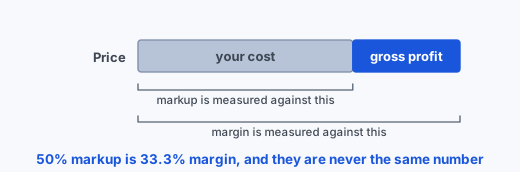
Now compare that with what your books say you need. Say your overhead runs 15 percent of revenue and you want 10 percent profit. The overhead and profit calculator prices the same $4,000 of cost at $5,333.33, a 33.3 percent markup. A clause that adds 25 percent to cost pays $5,000, so this change comes in $333.33 short of your own targets.
That gap is what the clause allows, not a mistake in your math. The dividing math behind your own target price is worked through in how much a contractor should mark up materials, so it is not repeated here. On a capped contract, check before you sign whether the change rate covers your real overhead and profit, because the difference comes out of your margin on every change.
Worked example: one $4,000 change order under four rules
Take an added doorway priced at $4,000 of direct cost: your own crew's labor and the materials, no subs. Here is the price your own targets need, and the most each of three published rates allows.
$4,000 of direct cost, priced four ways.
| Pricing rule | Markup on cost | Price | Margin |
|---|---|---|---|
| Your own books: 15% overhead and 10% profit taken from the price | 33.3% | $5,333.33 | 25% |
| 25% added to cost, the TxDOT rate on labor and on materials | 25% | $5,000.00 | 20% |
| VA clause at its ceiling on a change under $20,000: 10% overhead, then 10% profit on cost plus overhead | 21% | $4,840.00 | 17.4% |
| Cornell rate for work the contractor does directly | 15% | $4,600.00 | 13% |
Prices and margins from the site's overhead and profit calculator and markup vs margin calculator on $4,000 of cost. The VA clause computes profit on direct cost plus overhead, which is why its 10 and 10 come to 21 percent on cost. The TxDOT line treats the $4,000 as cost with labor taxes and insurance already in it; TxDOT itself pays those as a separate 55 percent of the bare labor cost, figured without the 25 percent.
Under these three clauses the same $4,000 change bills from $4,600 to $5,000, while your own targets need $5,333.33.
Look hard at the VA line. Why 10 and 10 can mean 20, 21 or 25 percent is covered in the materials markup post; the point here is which one a clause means. The VA clause figures profit on cost plus overhead, so its 10 and 10 is 21 percent, while the site's overhead and profit chart reads 10 and 10 as shares of the price, 25 percent. Check which base your clause uses before you fill in the rate.
Markup on subcontractor change orders
Each of the four documents lets the general contractor mark up a sub's change, and three of them set a lower rate for it than for the contractor's own work. Cornell lets the sub take 15 percent and the GC 10 percent on top. Its own example, on $1,000 of the sub's cost, gives the sub $150 and the GC $115, because the GC's 10 percent rides on the sub's marked up price.
GSA cuts the rate in half. A firm gets 50 percent of its own negotiated overhead and profit rates on a sub's direct costs, no more than 10 percent combined, and nothing for a sub more than two tiers down. TxDOT pays the prime a flat 5 percent of the sub's actual invoice for administrative cost and profit. The VA applies its declining scale to each upper tier's net increased cost, for up to three tiers.
Whether overhead and profit belong on sub work at all is answered on the overhead and profit chart. The contract question is narrower: what rate, on what base, and how many tiers deep.
Overtime, credits, bonds and processing fees
These rules in the same four documents move the final number.
- Overtime premium: Cornell's change order calculator says to make sure there is no markup on the premium portion of overtime, so mark up the straight time hours and carry the premium at cost. None of the other three documents here addresses overtime premium.
- Credit items inside an add: the VA clause deducts credit items before overhead and profit are added, and limits the fee to the net increase. A change that adds $3,000 of work and deletes $1,000 earns markup on the $2,000 net.
- Deductive changes: on a change that only removes work, the VA clause measures the credit by your reasonable cost of the deleted work and says reasonable overhead and profit are properly part of that downward adjustment, with the amount negotiable. The owner's credit can include the markup, not just bare cost.
- Bond and insurance: TxDOT adds 1 percent of the total force account payment for the bond increase. When bond or insurance premiums are figured as a percentage of the change, GSA applies those markups after overhead and profit, and not at all if the costs already sit in your overhead rate.
- Proposal and processing costs: GSA's clause lets a firm include the labor hours it spends preparing a change proposal as direct cost, and treats an outside consultant's proposal work as other direct cost, but only when its paragraph (k) conditions are met, including that the effort was not reasonably foreseeable at award and the cost is not already in the overhead rate. The VA clause takes the opposite line: review and coordination, estimating and expediting of contract changes count as supervision and are included in its overhead and fee percentages.
None of the four documents provides a flat processing fee per change, and GSA's paragraph (h)(9) says no markup is applied to a firm's costs other than those the clause specifies. On a contract you write yourself, a processing fee or a minimum charge per change only works if it is written into the contract before the job starts.
Writing the markup on the change order
Show the markup as its own line, under the cost lines, with the rate and the base it is applied to: for example, overhead and profit at 25 percent of $4,000. The change order template carries the line items and the price for this change, then the original contract price and the revised contract price, so the owner sees the cost, the markup and the new total on one page.
If your base contract does not name a change order markup, put one in before work starts, with one rate for your own work and a lower one for sub work, the same structure three of the clauses above use.
Contract terms and state rules vary, so have a construction attorney review the changes clause in any contract you are about to sign.
Overhead and profit calculator, Change order template, Markup vs margin calculator, Overhead and profit chart. Free, no signup, nothing to install.
Questions people ask
What is a normal markup on a change order?
There is no single normal number. In the four published contracts above the stated rates run from 5 percent of a sub's invoice for the prime (TxDOT) to 25 percent on your own labor and materials (also TxDOT), with Cornell capping all markup percentages combined at 25 percent and GSA leaving overhead to negotiation. Your contract's changes clause decides. With no rate in it, the markup is part of the price you and the owner agree on.
Can a contractor mark up subcontractor change orders?
Under the clauses shown here, yes. Cornell allows the GC 10 percent on top of the sub's 15 percent, GSA allows half the firm's own rates up to 10 percent combined within two tiers, TxDOT pays the prime 5 percent of the sub's invoice, and the VA applies its declining scale to each upper tier's net increased cost for up to three tiers.
Is change order markup the same as overhead and profit?
In most clauses the markup is the overhead and profit allowance. The difference is the base. A clause adds its percent to cost, while overhead and profit from your books are shares of revenue. On $4,000 of cost, 15 percent overhead and 10 percent profit taken from the price is $5,333.33, a 33.3 percent markup; 25 percent added to cost is $5,000.
Can I charge a fee just for processing a change order?
Not as a flat fee under any of the four public clauses shown here. GSA's clause lets you carry your own proposal preparation hours as direct labor cost when its conditions are met, while the VA clause says estimating, review and expediting of changes are already inside its overhead and fee percentages. On your own contract, a processing fee has to be written in before the job starts.
Does the markup apply to a deductive change order?
Under the VA clause, yes, in the owner's favor: a reasonable allowance for overhead and profit is properly included in the downward adjustment for a change that only deletes work, and the amount is negotiable. When a change mixes adds and credits, the same clause takes the credits off first and limits the fee to the net increase.
Do I get markup on overtime hours?
Of the four documents here, only Cornell's addresses it: its change order calculator excludes markup on the premium portion of overtime, so the straight time hours are marked up and the premium is billed at cost. Check your own changes clause for an overtime rule.
Sources
- Texas Department of Transportation, 2024 Standard Specifications for Construction, Items 1 to 10 (Item 9, Article 9.7, Payment for Extra Work and Force Account Method), Sections 9.7.1.1 to 9.7.1.8: 25% labor, 55% insurance and taxes, 25% materials, 15% equipment, 5% subcontracting, 1% bond.
- VA Acquisition Regulation 852.243-70, Construction Contract Changes, Supplement (SEP 2019), Paragraph (b)(1) declining scale, (c)(1) costs included in the percentages, (c)(2) and (c)(3) credits and deductive changes.
- GSA Acquisition Regulation 552.243-71, Equitable Adjustments (Mar 2019), Paragraph (h), markups: profit cap, subcontractor tiers, bond and insurance; paragraph (j), proposal preparation costs.
- Cornell University Facilities and Campus Services, Change Order Fee Percentage Calculator, Article 4.01E of General Conditions (updated 12.19.19), Article 4.01E rates: 15% own work, sub 15% plus GC 10%, sub-sub 15% plus 5% and 5%, 25% aggregate cap, no markup on overtime premium.