How Many Bags of Concrete for a Mailbox Post?
A mailbox post in a 10 inch hole 2 ft deep takes two 80 lb bags or three 60 lb bags of concrete. Bag counts for 8, 10 and 12 inch holes.
Open the free concrete footing calculator Free, no signup. Read on if you want the detail first.The short answer: two 80 lb bags or three 60 lb bags
A mailbox post set in a round hole 10 inches across and 2 feet deep takes two 80 lb bags or three 60 lb bags of concrete mix. The hole holds 1.09 cubic feet, and 1.2 cubic feet once a 10 percent waste allowance is added. With a 4x4 set in the concrete, the calculator takes the post out and the pour drops to 0.92 cubic feet, about 1 cubic foot with waste, which is still three 60 lb bags or two 80 lb bags, or three 50 lb bags.
Those counts come from the concrete footing calculator, which figures a 60 lb bag at 0.45 cubic feet and an 80 lb bag at 0.60. Those are the yields Quikrete publishes for its Concrete Mix No. 1101, a mix its data sheet lists for pipe and post footings among other uses.
The hole decides the count, not the mailbox. A 12 inch hole 3 feet deep needs five 80 lb bags, while an 8 inch hole 2 feet deep needs two. Dig first, measure what you dug, then count.
Bags of concrete by hole size
One round hole, nothing standing above grade, 10 percent waste, from the concrete footing calculator with Pier shape set to Round post hole, post fixed on top, which counts the whole hole as concrete.
| Hole diameter | Depth | Concrete with waste | 60 lb bags | 80 lb bags |
|---|---|---|---|---|
| 8 in | 2 ft | 0.8 cu ft | 2 | 2 |
| 8 in | 2.5 ft | 1 cu ft | 3 | 2 |
| 8 in | 3 ft | 1.2 cu ft | 3 | 2 |
| 10 in | 2 ft | 1.2 cu ft | 3 | 2 |
| 10 in | 2.5 ft | 1.5 cu ft | 4 | 3 |
| 10 in | 3 ft | 1.8 cu ft | 4 | 3 |
| 12 in | 2 ft | 1.7 cu ft | 4 | 3 |
| 12 in | 2.5 ft | 2.2 cu ft | 5 | 4 |
| 12 in | 3 ft | 2.6 cu ft | 6 | 5 |
These count the whole hole. Set Pier shape to Round post hole, 4x4 set in the concrete and the calculator takes the post out: the 10 inch hole 2 feet deep stays at three 60 lb or two 80 lb bags, and the 8 inch hole 2 feet deep drops to one 80 lb bag.
Two more inches of width or six more inches of depth each add an 80 lb bag to the 10 inch hole 2 feet deep. A 12 inch hole at 2 feet and a 10 inch hole at 2.5 feet both take three.
A square hole holds more than a round one of the same width. A square hole 10 inches on a side and 2 feet deep comes to 1.39 cubic feet before waste and 1.5 with it, which is four 60 lb bags or three 80 lb bags.
How to enter a mailbox post in the calculator
For a hole dug with a post hole digger or auger, set Pier shape to Round post hole, 4x4 set in the concrete when the post stands in the concrete, or to Round post hole, post fixed on top to count the whole hole. A square hole goes in as Square pad or form, which counts the whole hole and adds the pier lines. Diameter or side is the width of the hole in inches, not the width of the post. Depth below grade is the depth of the hole in feet.
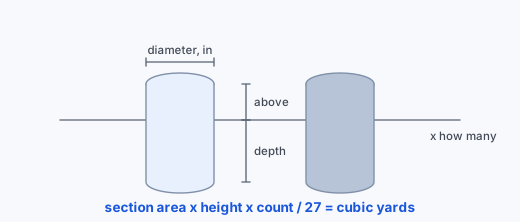
Set Height above grade to 0, because the concrete stops in the ground. How many piers is 1 for a single mailbox. Leave Waste allowance at 10 percent. Dropping it to 0 does not change this hole: counted whole, the 10 inch hole 2 feet deep reads 1.1 cubic feet and still comes to three 60 lb bags or two 80 lb bags.
Read the 50 lb bags, 60 lb bags and 80 lb bags rows. Either round post hole shape leaves out the Sonotube, Vertical rebar and Bearing at 2,000 psf rows and the post bases line, which are written for piers that carry a deck or a building and which a mailbox post in a dug hole does not need. Square pad or form still prints them, and a square post hole needs none of them either.
What the post and the soil cap take out
With Pier shape on Round post hole, 4x4 set in the concrete, the calculator takes the post out at its actual 3 1/2 by 3 1/2 inches for the full depth, so the 10 inch hole 2 feet deep drops from 1.09 to 0.92 cubic feet. It does not know you will cap the top few inches with soil, so its count still leaves a margin rather than a shortfall.
Quikrete's data sheet for its Fast-Setting Concrete Mix gives its own worked figure: two 50 lb bags set a 3 inch square post in a 9 inch diameter hole 30 inches deep. The same hole in the calculator, with no waste, holds 1.1 cubic feet counted whole and 0.89 with a 4x4 set in it, which it turns into three 50 lb bags at 0.375 cubic feet each. A 3 inch post takes out less than a 4x4, and part of the remaining gap is the 3 to 4 inches at the top that the mix stops short of, which the calculator leaves in.
The round post hole shapes print 50, 60 and 80 lb bag rows. The 50 lb row uses 0.375 cubic feet a bag, the yield Quikrete prints for the 50 lb bag of both its Concrete Mix and its Fast-Setting mix. The fast-setting mix also comes in a 60 lb bag rated at 0.45 cubic feet, which matches the 60 lb row.
How big and how deep to dig
Quikrete's fast-setting data sheet says to dig the hole about 3 times the diameter of the post, and that hole depth should be 1/3 of the overall post height.
A roadside mailbox has one more limit. The Postal Service's bulletin says the Federal Highway Administration has determined that wooden mailbox supports no larger than 4 by 4 inches, or a 2 inch diameter standard steel or aluminum pipe, buried no more than 24 inches, should safely break away if struck by a vehicle. The 2.5 and 3 foot rows in the table go deeper than that 24 inch figure, so for a roadside support, check with your local Post Office before you dig past 2 feet.
For any depth under 3 feet, the calculator prints a frost warning: under three feet is below the frost line only in the warmest parts of the country, so check the frost depth your building department publishes before you dig. That warning is written for piers that carry a structure, the subject of how deep a deck footing should be. A breakaway mailbox support pulls the other way, so where the frost depth and the 24 inch figure disagree, ask your local Post Office and your building department before you dig.
What the Postal Service asks for
Height and setback come from the Postal Service, not from the concrete. Its Postal Bulletin 22702 says: "Generally, customers must install mailboxes at a height of 41-45 inches from the road surface to the bottom of the mailbox or point of mail entry." It also says: "Also, customers must set mailboxes back 6-8 inches from the front face of the curb or road edge to the mailbox door."
Because road and curb conditions vary, the bulletin says the Postal Service recommends that customers contact their local Post Office before putting up or replacing mailboxes and supports.
On the post itself, the bulletin says customers own and control the supports for curbside mailboxes and are responsible for keeping posts neat and adequate in strength and size. It names heavy metal posts, concrete posts and farm items such as milk cans filled with concrete as examples of potentially dangerous supports, and says the ideal support bends or falls away when struck by a vehicle. The mailbox has to be securely attached to its post, and the box and post have to be painted and kept free of rust.
The bulletin does not say whether a post may be set in concrete. A concrete footing around a wooden 4 by 4 is not the same thing as a concrete post, but if you are unsure what your route accepts, the local Post Office is the place to ask.
Setting the post with fast-setting mix
Quikrete's fast-setting data sheet lays out a dry pour method for posts. With the 811 call added first, the steps are:
- Call 811 48 to 72 hours before digging so buried lines are marked.
- Dig the hole about 3 times the width of the post, with a depth of about 1/3 of the post's overall height.
- Stand the post in the hole and pour the dry mix in, up to about 3 to 4 inches from the top of the hole.
- Add about 1 gallon of water per 50 lb bag until the mix is saturated. For holes deeper than 30 inches, fill in stages.
- Fill the top 3 to 4 inches with soil or sod.
- The mix sets in 20 to 40 minutes. Wait 4 hours before the post takes any strain, such as hanging the mailbox.
Regular Concrete Mix No. 1101 is set differently. Its data sheet says to put 6 inches of dry mix in the bottom of the hole, position the post level and plumb, mix the concrete with water before it goes in the hole, taper the top away from the post so rain runs off, and wait 24 hours before the post takes any strain. Its 60 lb and 80 lb bags yield the 0.45 and 0.60 cubic feet the calculator uses, and the fast-setting 60 lb bag yields the same 0.45.
Call 811 before you dig
The Pipeline and Hazardous Materials Safety Administration says calling 811 reaches the one call center, that both the call and the marking of the lines are free, and that every digging project needs the call, even small ones like planting trees or shrubs.
It also says all states require by law that you call 48 to 72 hours before digging. The companies that operate underground lines then mark them with flags or paint, and the hole goes where the marks are not.
More than one post
For a double mailbox stand or a row of posts, set How many piers to the number of posts instead of multiplying one post's count. The calculator rounds the total once. Four 10 inch holes 2 feet deep come to 4.8 cubic feet with waste counted whole, which is eleven 60 lb bags or eight 80 lb bags, or 4.1 cubic feet with a 4x4 set in each, which is ten 60 lb bags or seven 80 lb bags.
For deck posts, the 4x4 post footings preset has the same calculator set up for eight footings. For a fence line, the fence post chart counts posts and bags together. When a pour grows past a handful of bags, the concrete bag chart converts cubic yards to 60 and 80 lb bags.
Concrete footing calculator, Concrete bag chart, Fence post chart, How deep a deck footing should be. Free, no signup, nothing to install.
Questions people ask
How deep should a mailbox post be?
Quikrete's fast-setting data sheet puts hole depth at 1/3 of the overall post height. For a roadside mailbox, the Postal Service bulletin cites the Federal Highway Administration finding that a wooden support no larger than 4 by 4 inches, or a 2 inch steel or aluminum pipe, buried no more than 24 inches, should break away safely if hit. Check your local frost depth with the building department and ask your local Post Office before you dig.
Can I set a mailbox post without concrete?
The Postal Service bulletin does not say a post must be set in concrete. It asks for supports that are neat and adequate in strength and size, says the ideal support bends or falls away when struck by a vehicle, and names concrete posts and milk cans filled with concrete as examples of potentially dangerous supports. If you are unsure what your route accepts, ask your local Post Office.
How high should a mailbox be from the ground?
The Postal Service bulletin says customers generally must install mailboxes at a height of 41-45 inches from the road surface to the bottom of the mailbox or point of mail entry, set back 6-8 inches from the front face of the curb or road edge to the mailbox door. It recommends contacting your local Post Office before putting one up.
Should I use 60 lb or 80 lb bags for a mailbox post?
Either one fills the hole; only the count changes. Quikrete rates its 60 lb bag at 0.45 cubic feet and its 80 lb bag at 0.60. For a 10 inch hole 2 feet deep the footing calculator gives three 60 lb bags or two 80 lb bags.
How many bags of concrete for a 4x4 mailbox post?
It depends mostly on the hole. With a 4x4 set in the concrete, at 2 feet deep with 10 percent waste, the footing calculator gives two 60 lb bags or one 80 lb bag for an 8 inch hole, three 60 lb or two 80 lb bags for a 10 inch hole, and four 60 lb or three 80 lb bags for a 12 inch hole. Counted as a whole hole, the 8 inch hole takes two 80 lb bags.
How long before I can hang the mailbox on the post?
Quikrete's fast-setting data sheet says the mix sets in 20 to 40 minutes and to wait 4 hours before the post is subjected to any strain. For regular Concrete Mix No. 1101, mixed with water before it goes in the hole, its data sheet says to wait 24 hours.
Sources
- United States Postal Service, Postal Bulletin 22702 (May 14, 2026), Mailbox Improvement Week: May 19 to 25, 2026, Mailbox height and setback, local Post Office contact, support rules and the FHWA breakaway figure
- QUIKRETE, Concrete Mix No. 1101 product data sheet (revised October 2022), Uses include pipe and post footings; yields of 0.45 cu ft per 60 lb bag and 0.60 cu ft per 80 lb bag; post setting method and 24 hour wait
- QUIKRETE, Fast-Setting Concrete Mix No. 1004 product data sheet (revised November 2025), Post setting method, hole size and depth, two 50 lb bags for a 3 in post in a 9 in by 30 in hole, set and wait times
- Pipeline and Hazardous Materials Safety Administration, Call Before You Dig!, 811 is free; states require the call 48 to 72 hours before digging