How Many BTU to Heat a 1,500 Square Foot House?
A 1,500 sq ft house needs 45,000 to 90,000 BTU an hour of heat, set by climate zone. See the output and furnace input for all seven zones.
Size the heat for your own house Free, no signup. Read on if you want the detail first.The short answer: 45,000 to 90,000 BTU an hour
A 1,500 square foot house with 8 foot ceilings needs about 45,000 to 90,000 BTU an hour of heat, depending on your climate zone. In zone 4, the mid Atlantic and the lower Midwest, the BTU calculator puts it at 67,500 BTU an hour.
That is the heat the house needs delivered. A furnace is sold by its input rating, which is bigger, because not all of the fuel becomes heat in the house. In zone 4 that means a furnace of about 84,375 BTU input at 80 percent AFUE, or 71,053 at 95 percent.
These numbers come from the square foot method. The calculator multiplies floor area by a heating factor for your zone and scales it for ceiling height. Use it to check that a quote is in the right range. It is not a load calculation, and the Manual J section below says why that matters.
1,500 square feet in every climate zone
Here is the same house run through the calculator in all seven zones at 8 foot ceilings. Heat output is what the house needs. The two input columns are the furnace size you would shop for at each efficiency.
| Zone | Where | Heat output, BTU/hr | Input at 80% AFUE | Input at 95% AFUE |
|---|---|---|---|---|
| 1 | South Florida, Hawaii, Texas Rio Grande Valley | 45,000 | 56,250 | 47,368 |
| 2 | The Gulf states | 52,500 | 65,625 | 55,263 |
| 3 | Carolinas, Georgia | 60,000 | 75,000 | 63,158 |
| 4 | Mid Atlantic, Kentucky | 67,500 | 84,375 | 71,053 |
| 5 | New England, Great Lakes | 75,000 | 93,750 | 78,947 |
| 6 | Upper Midwest, Montana | 82,500 | 103,125 | 86,842 |
| 7 | Northern MN, northern Maine | 90,000 | 112,500 | 94,737 |
Calculator inputs: 1,500 sq ft, 8 foot ceilings, one run per zone. Sun, occupants and the kitchen only feed the cooling side, so they do not move these numbers.
How many BTU per square foot for heating
The calculator's heating factor runs from 30 BTU an hour per square foot in zone 1 to 60 in zone 7, at an 8 foot ceiling. Each zone adds 5.
- Zone 1: 30 BTU per square foot
- Zone 2: 35 BTU per square foot
- Zone 3: 40 BTU per square foot
- Zone 4: 45 BTU per square foot
- Zone 5: 50 BTU per square foot
- Zone 6: 55 BTU per square foot
- Zone 7: 60 BTU per square foot
Floor area times the factor for your zone gives the heat output, and a taller ceiling scales it up in proportion. Measure only the conditioned floor area, the rooms you actually heat. The square footage calculator adds up odd shaped rooms.
Be wary of any per square foot number quoted without a zone. The Department of Energy makes the same point about the common cooling rule of one ton per 400 to 500 square feet: it ignores local climate and how efficient the house is.
Find your climate zone
Pick the zone in the calculator whose description fits where you live. If you are near a border, look up your county. Pacific Northwest National Laboratory publishes the energy code climate zone for every county in the country in a guide for the Department of Energy, PNNL-33270. A few entries from it:
- Miami-Dade County, Florida: zone 1A
- Cameron, Hidalgo and Willacy Counties, Texas: zone 1A, moved down from zone 2 in the 2021 update
- Harrison County, Mississippi: zone 2A
- Mecklenburg County, North Carolina: zone 3A
- Davidson County, Tennessee: zone 3A, moved down from zone 4 in the 2021 update
- Middlesex County, New Jersey: zone 4A
- Cook County, Illinois: zone 5A
- Denver County, Colorado: zone 5B
- Hennepin County, Minnesota: zone 6A
- Cook County, Minnesota, and Aroostook County, Maine: zone 7. Every other county in Maine is zone 6.
The letter after the number is a moisture regime, A, B or C. The square foot heating figure does not use it, so go by the number. Zone 8 exists too, but the guide notes the only subarctic regions in the United States are in Alaska.
Worked example: 1,500 square feet in zone 5
Say the house sits in zone 5, New England or the Great Lakes, with 8 foot ceilings. Enter 1,500 for floor area and 8 for ceiling height, and pick zone 5. The calculator returns three heating lines.
- Heating output needed: 75,000 BTU an hour.
- Furnace input at 80 percent AFUE: 93,750 BTU an hour.
- Furnace input at 95 percent AFUE: 78,947 BTU an hour.
On a quote, check that the furnace's output covers the load. A bigger input does not make a better furnace.
Ceiling height is the one input besides area and zone that moves the heating number. The same zone 5 house needs 84,375 BTU an hour with 9 foot ceilings and 93,750 with 10 foot ceilings.
For a bigger house, the furnace size for 2,000 square feet page has that run done in a mixed climate.
Output versus input: read the AFUE
AFUE stands for annual fuel utilization efficiency. The Department of Energy defines it as the heat actually delivered to your house compared with the fuel supplied to the furnace. The higher the AFUE, the more efficient the system.
The Department of Energy's home heating infographic puts old, low efficiency systems at 56 to 70 percent AFUE, mid efficiency systems at 80 to 83 percent and high efficiency systems at 90 to 98.5 percent. That is why the calculator prints two input figures. It divides the heat output by 0.80 for one and by 0.95 for the other.
So when you ask whether a 60,000 BTU furnace is enough, first find out whether 60,000 is the input or the output. At 80 percent AFUE, zone 1 needs 56,250 BTU of input and zone 2 needs 65,625. At 95 percent, zone 2 needs 55,263 and zone 3 needs 63,158.
When the square foot number is wrong
The square foot method knows your floor area, ceiling height and zone. It does not know your windows, your insulation, how much air leaks in or which way the house faces. Those are the things a real load calculation counts.
That calculation is ACCA Manual J. The Air Conditioning Contractors of America describes it as the national ANSI recognized standard for producing HVAC equipment sizing loads, and the Department of Energy's consumer guide says your contractor should use it to calculate the proper size of HVAC equipment. Ask for the Manual J report with any quote and compare its heating load with the table above.
Oversizing costs you too. The Department of Energy says a heating system that is too big for your home will cost more to operate. The NEEP heat pump guide adds that grossly oversized equipment can lead to excessive cycling and low efficiency, and that load calculations already have safety factors built in, so you should not pad them.
If you plan to insulate or air seal, do it first. The NEEP guide says planned weatherization work should come before sizing, because it reduces the size and cost of the system. The insulation calculator counts the batts or bags for an attic or wall.
Sizing a heat pump for 1,500 square feet
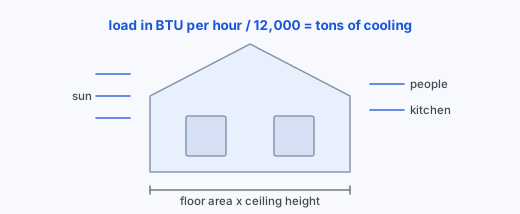
A heat pump carries both loads, so it has two numbers to meet. In zone 5 the calculator puts the 1,500 square foot house at 75,000 BTU an hour of heat but only 33,100 BTU an hour of cooling, which it rounds to a 3 ton unit.
For a heat pump that replaces the whole heating system in a cold climate, the NEEP guide says to match its capacity at the design temperature to 100 to 115 percent of the estimated heating load, without auxiliary heat. The other option it gives is to size for 75 to 85 percent and add just enough supplemental heat to make up the difference. The guide says cold climates may be taken as zone 4 and colder.
Read the capacity off the manufacturer's extended performance tables at your local design conditions, the guide says. And use a Manual J heating load, not the square foot figure, for the number you match it to.
For cooling sizes by floor area across all seven zones, see the air conditioner size chart.
BTU calculator, Furnace size for 2,000 sq ft, Air conditioner size chart, Insulation calculator. Free, no signup, nothing to install.
Questions people ask
How many BTU per square foot do you need for heating?
The calculator uses 30 BTU an hour per square foot in zone 1, rising by 5 a zone to 60 in zone 7, at an 8 foot ceiling. Treat that as a range for checking quotes. A Manual J for your actual house replaces it.
What size furnace do I need for a 1,500 square foot house?
By the square foot method, an input of 56,250 BTU in zone 1 up to 112,500 in zone 7 at 80 percent AFUE, or 47,368 to 94,737 at 95 percent. Zone 4 lands at 84,375 and 71,053. The heat those furnaces deliver is 45,000 to 90,000 BTU an hour.
Is 60,000 BTU enough to heat 1,500 square feet?
As heat output, 60,000 BTU an hour is what the calculator gives for zone 3, so it covers zones 1 to 3. As furnace input at 80 percent AFUE it covers zone 1 only. At 95 percent AFUE it covers zones 1 and 2.
What is the difference between BTU input and output on a furnace?
Input is the fuel the furnace burns in an hour. Output is the heat that reaches the house. AFUE is the share of the fuel's heat that gets delivered, so an 80 percent furnace needs a bigger input than a 95 percent furnace to deliver the same heat.
How many BTU heat pump do I need for 1,500 square feet?
Size it to the heating load at your design temperature, not to the cooling tons. For a whole house heat pump in a cold climate, NEEP recommends capacity of 100 to 115 percent of the heating load at that temperature, or 75 to 85 percent with supplemental heat. In zone 5 the square foot heating figure is 75,000 BTU an hour, but get a Manual J load before you buy.
Does ceiling height change how many BTU I need?
Yes. The calculator scales the heating number by ceiling height over 8 feet. In zone 5, 1,500 square feet needs 75,000 BTU an hour at 8 feet, 84,375 at 9 feet and 93,750 at 10 feet.
Do sun exposure and the number of people change the heating size?
Not in this calculator. Sun, occupants and the kitchen only feed the cooling load. In zone 5 the heat output stays at 75,000 BTU an hour whether you pick average sun or full sun, while the cooling load moves from 33,100 to 35,950 BTU an hour.
Sources
- U.S. Department of Energy, Consumer Guide to Home Heating and Cooling (DOE/EE-2464, August 2021), Defines AFUE, warns that oversized cooling systems can cost too much and that the one ton per 400 to 500 square feet rule ignores climate and house efficiency, and says contractors should size equipment with ACCA Manual J.
- U.S. Department of Energy, Energy Saver, Home Heating infographic (2014), AFUE ranges for low, mid and high efficiency heating systems, and the warning that a system too big for the home costs more to operate.
- NEEP, Guide to Sizing and Selecting Air-Source Heat Pumps in Cold Climates (rev. 04/08/20), hosted by DOE Building Science Education, Cold climate means IECC zone 4 and higher, the 100 to 115 percent and 75 to 85 percent capacity targets, extended performance tables, no padding of load calculations, and weatherization before sizing.
- Pacific Northwest National Laboratory, Guide to Determining Climate Zones by County: Building America and IECC 2021 Updates (PNNL-33270, September 2022), County by county climate zones, the A, B and C moisture regimes, the Davidson County, Tennessee and lower Rio Grande Valley, Texas changes, Aroostook as the only zone 7 county in Maine, and subarctic zone 8 found only in Alaska.
- Air Conditioning Contractors of America, Manual J Residential Load Calculation, ACCA's description of Manual J as the national ANSI recognized standard for producing HVAC equipment sizing loads.