How Much Should a Handyman Charge per Hour?
Build a handyman hourly rate from your pay, overhead and billable hours. Example: $60,000 pay, $18,000 overhead and 60% billable comes to $75.23 an hour.
Open the free hourly rate calculator Free, no signup. Read on if you want the detail first.The short answer: your costs divided by the hours you can bill
Charge enough to cover your pay, your overhead and the hours you cannot bill, plus a profit margin. Run through the hourly rate calculator, $60,000 of pay and $18,000 of overhead over 48 weeks of 40 hours, with 60% of those hours billable and a 10% margin, comes to $75.23 an hour.
That is a worked example of the method, not a market price. Your number moves with three inputs: what you want to earn, what the business costs to run, and how many hours a customer actually pays for. Put in your own and the calculator rebuilds the rate.
A national average tells you what homeowners paid, not whether that rate covers your truck, your insurance and the hours you spend driving between calls.
The worked example, line by line
Inputs: $60,000 a year of pay, $18,000 a year of overhead, 48 working weeks, 40 hours a week on the tools, 60% of those hours billable, and a 10% profit margin.
Every figure is the hourly rate calculator's output for those inputs:
| Line | Result | What it means |
|---|---|---|
| Hours worked a year | 1,920 | 48 weeks of 40 hours |
| Billable hours at 60% | 1,152 | the hours a customer pays for |
| Pay plus overhead to cover | $78,000.00 | $60,000 of pay and $18,000 of overhead |
| Break even rate | $67.71 an hour | covers pay and overhead with zero profit |
| With 10% profit margin | $75.23 an hour | the rate to quote |
| Day rate, 8 hours | $601.85 | a full billable day at that rate |
| Revenue this implies | $86,666.67 a year | the billable hours sold at that rate |
Profit here is a margin, a share of the price, not a markup on cost.
Because the profit is a share of the price, 10% on a $67.71 break even lands at $75.23. The material markup post shows the same margin and markup difference for the parts you buy for a job.
Billable hours, not 40 a week, set the rate
A handyman sells hours, but not every hour worked can be sold. Driving between calls, writing estimates, picking up parts, returning calls and doing the books all take time that no customer pays for unless you charge for it separately.
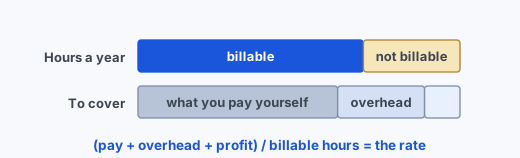
Change only the billable share and the same $78,000 of pay and overhead gives very different rates. Each row is the calculator's output with the other inputs unchanged.
$60,000 pay, $18,000 overhead, 48 weeks of 40 hours, 10% margin:
| Billable share | Billable hours | Break even | With 10% margin | Day rate, 8 hours |
|---|---|---|---|---|
| 50% | 960 | $81.25 | $90.28 | $722.22 |
| 60% | 1,152 | $67.71 | $75.23 | $601.85 |
| 70% | 1,344 | $58.04 | $64.48 | $515.87 |
Many short calls in a day mean more driving between them, so track a few weeks of your real hours before you pick the share. The hourly rate chart lays out rates across pay targets and billable shares if you want to see the spread at a glance.
What goes in the overhead number
Overhead is every business cost that is not your pay and not a specific job's materials. Total a full year of it from your bank statements or last year's Schedule C, which has separate expense lines for advertising, car and truck expenses, insurance other than health, legal and professional services, office expense, supplies, and taxes and licenses.
- Truck: the loan or lease payment, fuel, insurance, repairs and registration. The mileage deduction calculator shows what the business miles are worth at the 2026 rates.
- Insurance: general liability and any other business policy.
- Tools you replace, plus consumables you do not bill to a job, such as blades, bits, caulk and fasteners.
- Phone and internet. The Schedule C instructions say the base rate of the first phone line into your home is not deductible, though business costs above it are.
- Licenses and registrations your state, county or city requires.
- Software, advertising, bookkeeping and other professional fees.
The example uses $18,000. If your list totals more, put your own figure in: overhead is spread over the same billable hours, so every extra dollar of it lands on the rate.
Your pay figure is before tax
The $60,000 in the example is what the business pays you before tax, not take-home pay. As a sole proprietor you owe self-employment tax on your profit on top of income tax.
The self-employment tax calculator puts 2026 self-employment tax on $60,000 of net profit at $8,477.73 for a single filer with no W-2 wages, 14.1% of the profit before any income tax. Set the pay target high enough to carry that.
Minimum charges and trip charges from the same math
A 20 minute repair costs you the same drive, parking and setup as a two hour one. A minimum charge covers that. One plain way to set it is one billable hour at your rate, $75.23 in the example, so no visit brings in less than an hour.
A trip charge is the other route. If you bill drive time or a flat trip fee separately, more of your hours become billable, and the rate the calculator gives comes down: moving from 60% to 70% billable in the example drops it from $75.23 to $64.48. Recover a drive one way or the other, not both.
Write the minimum and any trip charge on the handyman estimate template before the job, so the invoice holds no surprise.
What an employed maintenance worker earns, and why your rate is higher
The closest Bureau of Labor Statistics occupation is general maintenance and repair workers. Its Occupational Outlook Handbook gives a median wage of $23.84 an hour, $49,590 a year, in May 2025. The lowest 10 percent earned less than $35,350 and the highest 10 percent more than $77,180.
Those are employee wages, not business rates. The handbook says its pay figures do not include self-employed workers. An employer pays for the truck, the tools, the insurance and the hours between jobs; a handyman in business pays all of it out of the hourly rate.
Put the median wage into the calculator as your pay: $49,590 of pay and $18,000 of overhead over 48 weeks of 40 hours, 60% billable with a 10% margin, gives $65.19 an hour, with a break even of $58.67. Earning an employee's median pay as a business takes a rate far above the employee's $23.84.
By the hour, by the job, or part time
Bill by the hour when the scope is unknown until a wall or a cabinet is open. Quote a flat price when you can see the whole job. Either way the hourly rate is the base: a flat price is your estimate of the hours times the rate, plus materials at your markup.
Part time does not lower the rate by itself, because half the hours carry the overhead. At $30,000 of pay and $8,000 of overhead over 48 weeks of 20 hours, 60% billable with a 10% margin, the calculator gives $73.30 an hour, close to the full time rate only because overhead fell to $8,000. Keep the full $18,000 of overhead with that $30,000 of pay and the same hours, and it gives $92.59, because 576 billable hours now carry the whole truck, insurance and tool bill.
Put the rate, the hours and any minimum charge on the handyman invoice template so the customer sees how the total was built.
Hourly rate calculator, Hourly rate chart, Handyman invoice template, Handyman estimate template. Free, no signup, nothing to install.
Questions people ask
Should a handyman charge by the hour or by the job?
Either works if the hourly rate underneath is right. Bill hourly when the scope is unknown, quote a flat price when you can see the whole job, and build the flat price from your estimated hours times your rate plus materials. A flat price that runs over still costs you those hours.
What is a fair minimum charge for a handyman?
Set it from your own rate rather than a number you read somewhere. One billable hour at your rate is a plain starting point, $75.23 in the worked example, because the drive, parking and setup cost the same on a small job as on a large one. Put the minimum on the estimate before you go.
How much should a handyman charge for a small job?
At least the minimum charge, then the hours at your rate plus materials. In the worked example, time past the first hour is billed at $75.23 an hour, with materials marked up separately.
Do handymen charge for travel time?
You can, as a trip fee or as billed drive time, or you can leave it unbilled and carry it in the rate through a lower billable share. Billing drive time raises your billable share: at 70% billable instead of 60%, the example rate falls from $75.23 to $64.48. Use one approach for a given drive, not both.
What is the going rate for a handyman?
This page does not quote one, because a market average does not cover your costs. The closest government figure is an employee wage: the Bureau of Labor Statistics puts the median for general maintenance and repair workers at $23.84 an hour in May 2025, and that figure leaves out the self-employed and the truck, tools, insurance and unbilled hours a business pays for.
Sources
- U.S. Bureau of Labor Statistics, Occupational Outlook Handbook, General Maintenance and Repair Workers, Median pay $23.84 an hour and $49,590 a year, May 2025; employee wages, self-employed workers not included
- IRS Instructions for Schedule C (Form 1040) (2025), Business expense lines, and the first home phone line rule