I Received a Notice to Owner in Florida: What Now?
A Florida notice to owner is not a lien on your house. See why a company you never hired sent it, and how releases and one affidavit stop you paying twice.
See the Florida notice to owner form Free, no signup. Read on if you want the detail first.Short answer: it is a warning, not a lien
A notice to owner is not a lien on your house. It is a notice from a company working on your project under your contractor, such as a subcontractor or a material supplier, telling you it is on the job and that Florida law lets it claim a lien if it is not paid.
What changes is how you pay your contractor from here on. Get a written release from that company each time you pay, and get your contractor's final payment affidavit before you make the last payment. Section 713.06(2)(a) of the Florida Statutes says the notice is not a lien, cloud, or encumbrance on the real property.
The form itself, and how the people who send it fill it in, is on the Florida notice to owner form page.
Why a company you never hired sent it
Florida's lien law gives subcontractors, sub-subcontractors and suppliers a lien right on your property even though they never signed anything with you. The price of that right is this notice. Section 713.06(2)(a) makes serving it on you a prerequisite to perfecting a lien and recording a claim of lien.
The notice has to be served before the sender starts work or no later than 45 days after it starts to furnish labor, services or materials. Because that clock runs from the sender's first day on your job, the notice comes early whether or not anyone is behind on payment. By itself it does not say anyone is unpaid.
Read the top of it. The statute's form opens with a warning in capital letters, and the line that matters most to you is this one: "TO AVOID A LIEN AND PAYING TWICE, YOU MUST OBTAIN A WRITTEN RELEASE FROM US EVERY TIME YOU PAY YOUR CONTRACTOR." Lower down, the form names who ordered the work, so you can see which contractor or subcontractor the sender is working for.
If your contract is over $2,500 and covers a home of up to four units, section 713.015(1) requires a lien law warning in it, in capitalized bold type of at least 12 point, on the front page or on a separate page, signed by you and dated. It gives the same advice: stipulate that before any payment is made, your contractor must provide a written release of lien from any person or company that has given you a notice to owner. That wording is on the Florida construction lien law notice page.
How long the sender can still file a lien
Two clocks run for the company that sent you the notice. It has 45 days from its first day furnishing labor or materials to serve you, under section 713.06(2)(a), and 90 days from its final furnishing to record a claim of lien, under section 713.08(5).
Take a supplier that first delivered to your job 20 days ago and made its last delivery 12 days ago. The Florida lien deadline calculator gives it 25 days left to serve the notice and 78 days left to record a claim of lien. If it is still delivering, the full 90 days are still ahead of it.
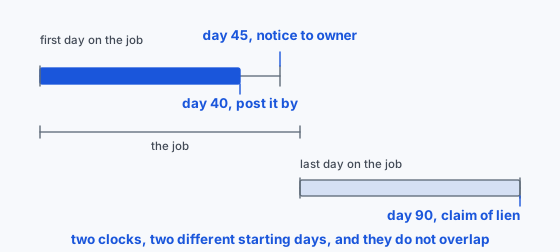
That second number is the one that matters to you. Until that company has been paid and has released its lien, or its 90 days run out with no claim recorded, its lien right on your job stays open.
How to avoid paying twice
The risk the warning describes is simple. You pay your contractor, the contractor does not pay the sender, and the sender records a lien against your house for what it is owed. You avoid that by tying each payment to proof that the senders have been paid.
- Keep every notice to owner with your contract, and make a list of each sender and what it supplies.
- Before each payment to your contractor, ask for a written release of lien from every company on that list, covering the work paid for up to that payment. The Florida lien waiver form page has the progress payment and final payment release forms.
- Ask for the contractor's affidavit with any payment if you want one. Section 713.06(3)(c)1 lets you require it before you pay, but it also says the affidavit does not relieve you of your responsibility to pay or cause to be paid all lienors giving notice.
- Hold the final payment until you have the contractor's final payment affidavit. Section 713.06(3)(d)5 says the final payment shall not be disbursed until that affidavit has been furnished to you.
- If the affidavit lists someone as unpaid, section 713.06(3)(d)2 lets you pay that bill in full directly, after giving the contractor at least 10 days' written notice, and deduct it from what you owe the contractor, if the balance still due on the contract covers those bills and the other senders who gave notice.
The contractor's final payment affidavit
This is the document that closes out the job. Under section 713.06(3)(d)1, when final payment comes due the contractor must give you a sworn affidavit stating that every lienor under the contract who timely served a notice to owner has been paid in full, or naming each one who has not and the amount due.
You may rely on it in making the final payment unless someone who served you a notice is missing from it, under section 713.06(3)(d)4. The contractor has no lien or right of action against you while in default for not giving it, and must deliver it at least 5 days before suing to enforce a lien. The blank statutory form is on the contractor's final payment affidavit page.
Check the names on it against your list of notices. If a sender who gave you notice is missing, section 713.06(3)(d)4 lets you pay that sender, and anyone listed in the affidavit who is entitled to payment from you, and you are then discharged of further responsibility under the contract except for any balance still due the contractor.
When the notice reached you matters
Section 713.06(3)(c)1 says you are under no obligation to any lienor, except laborers, from whom you had not received a notice to owner at the time you made a payment. So write the date it arrived on the notice and keep the envelope. Section 713.06(2)(a) also sets an outer limit: whatever the 45 days allow, the notice must be served before you disburse the final payment after the contractor has given you the final payment affidavit.
Section 713.06(3)(c)4 adds that a person who had to serve a notice, did not, and whose time to serve has expired is not entitled to be paid by you just because the contractor listed them in an affidavit. Section 713.06(2)(a) goes further: failing to serve the notice, or to serve it on time, is a complete defense to enforcement of a lien by any person.
Outside Florida the rules for subcontractors and suppliers you never hired are different; the post on whether a contractor can put a lien on your house without a contract covers Texas, Arizona, Minnesota and Washington.
What to keep on file
Keep these together until the job is done and every lien deadline has passed:
- Your contract, including the signed lien law disclosure if your contract needed one.
- Every notice to owner, with the date it reached you.
- A list of each sender, what it supplies, and who ordered its work.
- Each release of lien, matched to the payment it covers.
- Proof of every payment to your contractor.
- The contractor's final payment affidavit.
For a short definition to share with someone else in your household, see the glossary entry on the notice to owner.
The notice form itself tells you to learn more from an attorney or the Florida Department of Business and Professional Regulation. Lien rules vary with the facts of each job, so have a Florida construction attorney confirm your situation before you withhold or redirect a payment.
Florida notice to owner form, Contractor's final payment affidavit, Florida lien waiver forms, Florida lien deadline calculator, Notice to owner, defined. Free, no signup, nothing to install.
Questions people ask
Is a notice to owner a lien on my house?
No. Section 713.06(2)(a) says the notice is not a lien, cloud, or encumbrance on the real property, and that serving it does not dispense with recording the claim of lien. It tells you the sender is on your job and could record a claim of lien later if it is not paid. Recording a claim of lien is a separate step, and section 713.08(5) gives the sender 90 days from its final furnishing to take it.
Why did I get a notice to owner from a company I never hired?
Because your contractor or one of its subcontractors hired it. Florida lets subcontractors and suppliers who have no contract with you claim a lien, and serving this notice is what they must do to keep that right. The form names who ordered the work.
Do I have to respond to a notice to owner in Florida?
The form does not ask you to sign or return anything. What it changes is how you pay: from then on, get a written release from the sender each time you pay your contractor, and hold the final payment until you have the contractor's final payment affidavit.
How do I avoid paying twice when I get a notice to owner?
Get a written release of lien from every company that sent you a notice before each payment to your contractor, and hold the final payment until the contractor gives you the final payment affidavit. If the affidavit lists an unpaid sender, you can pay that company directly from the balance after giving the contractor at least 10 days' written notice.
What is a contractor's final payment affidavit in Florida?
A sworn statement under section 713.06(3)(d)1 that every lienor who timely served a notice to owner has been paid in full, or listing each unpaid one and the amount due. You hold the final payment until you get it, and the contractor must deliver it at least 5 days before suing to enforce a lien.
Can a supplier lien my house if I already paid my contractor?
It can, if it served you a notice, was not paid, and records its claim in time. The statutory warning says Florida law allows some unpaid contractors, subcontractors and material suppliers to file liens against your property even if you have made payment in full. That is why the releases matter. Under section 713.06(3)(c)1 you are under no obligation to a lienor, other than a laborer, from whom you had not received a notice when you made a payment.
Sources
- Florida Statutes, section 713.06, Liens of persons not in privity; proper payments, (2)(a) notice to owner, the 45 days and the complete defense, (2)(c) the notice form and warning, (3)(c) and (3)(d) payments and the final payment affidavit.
- Florida Statutes, section 713.015, Mandatory provisions for direct contracts, (1) the lien law warning required in residential direct contracts over $2,500.
- Florida Statutes, section 713.08, Claim of lien, (5) the 90 days from final furnishing to record a claim of lien.