What size generator do you need to run a refrigerator?
A 725 W fridge needs about 2,200 starting watts on a generator. See running vs starting watts, fridge plus freezer sizes, fuel per day and CO safety.
Open the free generator size calculator Free, no signup. Read on if you want the detail first.

The short answer
Size a portable generator for about 2,200 starting watts if one frost free 16 cubic foot refrigerator is all you need to keep running. That is what the generator size calculator returns when the 725 W nameplate wattage Virginia Tech Extension lists for that refrigerator is entered as its running watts, with the calculator's 3x starting multiplier for a standard induction motor.
A nameplate figure is the label rating, not a measured running draw, and published running figures for a refrigerator are much lower: Honda lists 200 running and 1,600 starting watts. Read your own fridge's label before you buy, then use the steps at the end of this page to size on it.
Calculator output for one refrigerator: 725 W entered as running watts, 3x starting multiplier, 20 percent reserve, 120 V, gasoline, 5 gallon tank.
| Line | Result | What it means |
|---|---|---|
| Running watts | 725 W | the Virginia Tech nameplate figure, entered as the running load |
| That motor starting | 2,175 W | 3x the running draw, for the moment the compressor kicks on |
| Running watts with reserve | 870 W | 20 percent headroom on the running load |
| Amps at 120 V | 7.3 A | at the running load with reserve |
| Generator to buy | 2,200 starting watts | the peak, rounded up to the next 100 |
| Fuel burn | 0.21 gal/hour | at the full running load |
| Runtime on a 5 gal tank | 24.1 hours | at the full running load |
| Fuel for 24 hours | 5 gal | one full day of outage |
Example figure. Every number is the calculator's output for the inputs above; change an input and they move.
Running watts versus starting watts
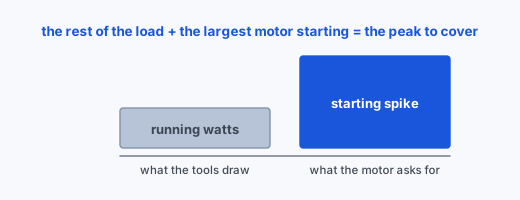
Running watts are what the fridge draws while its compressor runs. Starting watts are the short burst the compressor motor needs to get moving. Champion Power Equipment and Honda both list the two figures separately for a refrigerator, and in both lists the starting figure is several times the running one.
A generator has to clear both. Its running output must cover everything that is on at once, plus some headroom, and its starting output must cover the moment the largest motor starts while everything else keeps running. The calculator works out both and gives you whichever is bigger, rounded up to the next 100 watts.
For a fridge on its own, the starting surge always wins. The 725 W fridge above needs 870 W of running capacity with reserve but 2,200 W to start, so a generator chosen on running watts alone would come up short the moment the compressor cycles on.
Find your fridge's real wattage
Start with the rating label on the fridge itself. Virginia Tech Extension notes that when the wattage is not listed, you multiply the current draw in amps by the voltage to get watts, and that most appliances in the United States use 120 volts.
If you cannot read the label, use published figures, but know they disagree with each other. That spread is why your nameplate matters more than any chart.
Published refrigerator and freezer figures from the sources linked at the end of this page:
| Source | Appliance | Watts listed | Starting watts |
|---|---|---|---|
| Virginia Tech Extension | Frost free refrigerator, 16 cu ft | 725 (nameplate) | not listed |
| Honda | Refrigerator | 200 running | 1,600 |
| Champion | Refrigerator | 150 to 400 running | 800 to 1,200 |
| Champion | Freezer | 100 to 500 running | 500 to 1,000 |
Published estimates, not measurements of your appliance. When in doubt, size on the higher figure.
One trap: a low running figure paired with a big starting figure does not fit a simple multiplier. Enter Honda's 200 running watts with the calculator's 4x setting and it returns only 800 starting watts, well under Honda's own 1,600. So when the label, the manual or the generator maker's chart gives a starting figure, put it in the calculator's starting watts box, which replaces the multiplier. Entered as the only load, Honda's 200 running and 1,600 starting watts return 1,600 starting watts.
Inverter compressors and the default motor
The calculator's 2x setting is labelled for an inverter or ECM motor. If your fridge's manual says it has one, the same 725 W fridge needs 1,500 starting watts at 2x instead of 2,200 at 3x. If you do not know what compressor you have, keep the 3x setting.
The calculator's default largest motor is 800 running watts, which is where it starts if you have no label and no manual. Entered as your only load at 3x, it returns 2,400 starting watts, 960 running watts with reserve, 0.23 gallons of gasoline an hour and 6 gallons for 24 hours.
Fridge plus freezer plus lights
The table below adds a chest freezer at 500 running watts, the top of Champion's freezer range, and 300 W of lights and phone charging to the 725 W fridge.
Calculator output for each load list, 3x multiplier, 20 percent reserve, 120 V, gasoline:
| Load list | Running watts | Peak starting watts | Generator to buy | Fuel for 24 hours |
|---|---|---|---|---|
| Fridge only | 725 W | 2,175 W | 2,200 | 5 gal |
| Fridge and freezer, one starts at a time | 1,225 W | 2,675 W | 2,700 | 9 gal |
| Fridge and freezer, both start together | 1,225 W | 3,675 W | 3,700 | 9 gal |
| Fridge, freezer and 300 W of lights, one starts at a time | 1,525 W | 2,975 W | 3,000 | 11 gal |
| Same list, both compressors start together | 1,525 W | 3,975 W | 4,000 | 11 gal |
Example figures. The both start together rows enter the two compressors as one 1,225 W motor, which is what the generator sees if they kick on at the same moment.
Honda's advice is to start appliances with high starting wattage at different times. That keeps you on the one at a time rows when you first plug in. Once both are running, though, each thermostat cycles on its own schedule, so the two compressors can still start together later. If your generator sits between the two rows, the higher one is the size with no gamble in it.
The bigger list also changes the cord. At 120 V the fridge, freezer and lights draw 15.3 A with reserve, and the calculator rates the inlet and cord for that load at 20 A. The fridge alone draws 7.3 A and rates at 15 A.
How much gas a fridge uses on a generator
The calculator assumes 3.5 kWh from a gallon of gasoline at the running load. The fridge alone burns 0.21 gallons an hour and runs 24.1 hours on a 5 gallon tank, so plan on 5 gallons a day. The fridge, freezer and lights list burns 0.44 gallons an hour, runs 11.5 hours on the same tank, and needs 11 gallons a day.
Those figures assume the full running load the whole time. Virginia Tech Extension notes that refrigerators cycle on and off, and suggests dividing the total time a fridge is plugged in by three to estimate its hours at full wattage. Treat the calculator's fuel line as a planning number for how much to store, and check your generator's own run time chart once you own one.
Run it outside, 20 feet away, with a CO alarm
The U.S. Consumer Product Safety Commission says never to run a portable generator inside a home, garage, basement, crawlspace or shed, and not on an outside porch or in a carport. Run it outside at least 20 feet from the house, with the exhaust pointed away from the home and any other building someone could enter. The CDC gives the same 20 foot distance from doors, windows and vents, and Ready.gov says generators and fuel belong outdoors at least 20 feet from windows, doors and attached garages.
Put battery operated carbon monoxide alarms on each level of the home. The CPSC calls a CO alarm the last line of defense and puts deaths from portable generator carbon monoxide at about 85 consumers a year. The CPSC names nausea, dizziness and weakness among the milder symptoms of CO poisoning, and says never to ignore an alarm: get outside immediately, then call 911.
Getting power from the generator to the fridge
Ready.gov says to connect appliances to a generator with heavy duty extension cords. Check the cord's amp rating against the calculator's amps line: 7.3 A for the fridge alone and 15.3 A for the fridge, freezer and lights. Our extension cords and GFCI toolbox talk covers cord inspection, and the voltage drop calculator shows what a long cord run costs you at the far end.
Feeding the house panel instead of plugging the fridge in directly is a different job. Connecting a generator to house wiring is work for a licensed electrician, and the sizing for that kind of setup, with a well pump and furnace on the list, is in what size generator to run a well pump and furnace.
Keep the food cold while you sort out power
Ready.gov says a refrigerator keeps food cold for about four hours and a full freezer holds its temperature for about 48 hours. Keep both doors closed and use a thermometer. Throw out food that has been at 40 degrees or higher for two hours or more.
Those windows tell you how long you have to get a generator running before food in the fridge is at risk, and why the freezer can wait longer than the fridge if you only have the starting watts for one at a time.
Quick sizing steps
- Read the running watts off the fridge label, or multiply its amps by its volts.
- Add the running watts of everything else you want on at the same time.
- Enter the biggest motor, usually the fridge or freezer compressor, as the largest motor.
- Pick 3x unless the manual says inverter or ECM motor, then pick 2x. If the label, the manual or the generator maker's chart gives the compressor's starting watts, enter that figure in the starting watts box instead.
- Buy a generator whose starting rating meets the calculator's figure and whose running rating covers the running watts with reserve.
- Store the fuel line for each day of outage you want to cover.
Generator size calculator, Generator for a well pump and furnace, Voltage drop calculator. Free, no signup, nothing to install.
Questions people ask
Will a 2000 watt generator run a refrigerator?
It can, if 2,000 is its starting rating and your fridge starts within it. Honda lists a refrigerator at 1,600 starting watts, which fits. The calculator puts a 725 W fridge at a 3x start at 2,200 starting watts, which does not, while the same fridge with an inverter or ECM compressor at 2x needs 1,500. Check which rating the 2,000 refers to, read your fridge's label, and run nothing else large while the compressor starts.
How long can a refrigerator go without power?
Ready.gov says a refrigerator keeps food cold for about four hours and a full freezer holds its temperature for about 48 hours. Keep the doors shut, check with a thermometer, and throw out food that has been at 40 degrees or higher for two hours or more.
Can I plug a refrigerator straight into a generator with an extension cord?
Yes. Ready.gov says to connect appliances to a generator with heavy duty extension cords. Match the cord to the load: the calculator puts the 725 W fridge at 7.3 A at 120 V with reserve, and rates the inlet and cord for that at 15 A. Keep the generator itself outside, at least 20 feet from the house per the CPSC and CDC, and run the cord in to the fridge.
How much gas does a generator use running a fridge?
The calculator puts a 725 W fridge at 0.21 gallons of gasoline an hour, 24.1 hours on a 5 gallon tank and 5 gallons for a full day, assuming 3.5 kWh per gallon at the full running load. Add a 500 W freezer and 300 W of lights and it rises to 0.44 gallons an hour and 11 gallons a day.
What size generator do I need for a refrigerator and a freezer?
For a 725 W fridge and a 500 W freezer, the calculator returns 2,700 starting watts if only one compressor starts at a time and 3,700 if both can start together. Since their thermostats cycle independently, 3,700 is the size that covers both starting at once.
Does the generator have to run all the time to save the food?
The sources on this page do not give an on and off schedule. Ready.gov gives about four hours of cold for a closed refrigerator and about 48 hours for a full freezer, which is the time food holds with no power at all. If you do run the generator in shifts, keep the doors shut, check temperatures with a thermometer, and size it on starting watts so the compressor can start each time the power comes back.
Sources
- U.S. Consumer Product Safety Commission, CPSC Urges Caution When Using Portable Generators as Tropical Storm Ian Continues its Path of Destruction, news release, September 29, 2022, Outside only, at least 20 feet from the house, exhaust away from buildings, CO alarms on each level, about 85 deaths a year
- Centers for Disease Control and Prevention, Use a Generator Safely, Keep a generator outside at least 20 feet from doors, windows and vents
- Ready.gov (FEMA), Power Outages, About four hours for a closed refrigerator, about 48 hours for a full freezer, the 40 degree rule, generators outdoors 20 feet from windows, doors and attached garages, heavy duty extension cords
- Grisso, Walker and Ignosh, ENERGY SERIES: Estimating Appliance and Home Electronic Energy Use, Virginia Cooperative Extension publication 2901-9014 (BSE-301NP), 2020, Frost free 16 cu ft refrigerator at a nameplate wattage of 725, watts from amps times volts, most US appliances on 120 volts, refrigerators cycle on and off
- American Honda Power Equipment, What Size Generator Do I Need?, Refrigerator at 200 running and 1,600 starting watts, start high starting wattage appliances at different times
- Champion Power Equipment, What Size Generator Do I Need?, Refrigerator 150 to 400 running and 800 to 1,200 starting watts, freezer 100 to 500 running and 500 to 1,000 starting watts