How Many Cinder Blocks for a 4x8 Raised Garden Bed?
A full 4x8 of soil takes 20 cinder blocks a course and 40 for two. See the 16 and 18 block layouts, the corner math, the cores and the soil.
Open the free concrete block calculator Free, no signup. Read on if you want the detail first.

The short answer
A 4x8 raised bed built from standard 8x8x16 cinder blocks takes 20 blocks per course if you want a full 4 by 8 ft of soil inside, so 40 blocks for a bed two courses high. If you mean the outside of the bed measures 4 by 8 ft, it is 16 blocks a course, and the common in between layout takes 18.
All three counts come from the concrete block calculator, run on the centerline length of each layout with an 8 in block, hollow, and no waste. Add 5 percent for breakage and the calculator rounds one course up to 21, 17 and 19 blocks.
Inside 4x8 or outside 4x8: why the counts differ
A cinder block wall is 8 in thick, nominal. Wrap that wall around a rectangle and the corners have to overlap somewhere, so the walls on one pair of sides run past the corners and the other pair sits between them.
That is why one phrase, a 4x8 bed, can mean three different builds. The question is which measurement you want to be 4 by 8 ft: the soil, the outside, or a mix of the two.
One course of nominal 8x8x16 block. The long walls run past the corners and the short walls sit between them.
| Layout | Long walls | Short walls | Per course | Soil space inside | Outside size |
|---|---|---|---|---|---|
| A: the outside is 4x8 | 6 each | 2 each | 16 | 2 ft 8 in by 6 ft 8 in | 4 ft by 8 ft |
| B: 4 ft wide inside, 8 ft long outside | 6 each | 3 each | 18 | 4 ft by 6 ft 8 in | 5 ft 4 in by 8 ft |
| C: the inside is a full 4x8 | 7 each | 3 each | 20 | 4 ft by 8 ft | 5 ft 4 in by 9 ft 4 in |
Per side counts are block calculator runs on each wall length at one course: 8 ft gives 6 block, 9 ft 4 in gives 7, 4 ft gives 3 and 2 ft 8 in gives 2. Sizes are nominal.
Layout A gives up a lot of growing room. Its soil space is under 3 ft wide. Iowa State University Extension puts a good width at 3 to 4 ft for a bed you can reach from both sides, and 1 1/2 to 2 ft for one you reach from one side only, so layout C, with 4 ft of soil, sits at the top of the two sided range.
None of the three layouts needs a half block or a cut. Every wall length is a whole number of 16 in blocks, which is why the sizes step in 16 in jumps.
Real block is a little smaller than its name. The industry table from the Concrete Masonry and Hardscapes Association gives a nominal 8x8x16 unit as 7 5/8 by 7 5/8 by 15 5/8 in, with the missing 3/8 in meant for a mortar joint. Laid dry, with no joints, each layout comes out slightly under the sizes in the table.
Worked example: one, two and three courses
To get these counts yourself, enter the centerline length in the block calculator. That is the line through the middle of the wall, measured all the way around. Layout A is 21.33 ft, layout B is 24 ft and layout C is 26.66 ft. Enter the height in feet: 0.6666 for one 8 in course, 1.3333 for two, 2 for three. Pick the 8 in block, hollow, and your waste.
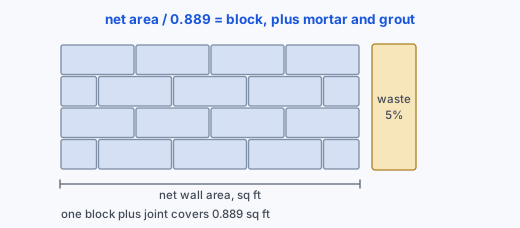
Type 0.6666 and 26.66, not 0.67 and 26.67. The calculator rounds any part of a block up to a whole block, so a length rounded up by a hundredth of a foot buys you one you do not need: 26.67 ft at one course returns 21 block before waste instead of 20.
Block to buy for each layout, at 0 percent and 5 percent waste.
| Courses (height entered) | A: 21.33 ft | B: 24 ft | C: 26.66 ft |
|---|---|---|---|
| 1 (0.6666 ft) | 16, or 17 with waste | 18, or 19 with waste | 20, or 21 with waste |
| 2 (1.3333 ft) | 32, or 34 with waste | 36, or 38 with waste | 40, or 42 with waste |
| 3 (2 ft) | 48, or 51 with waste | 54, or 57 with waste | 60, or 63 with waste |
Block calculator, 8 in block, no fill. Waste is 0 percent, then 5 percent.
If you have seen 36 quoted for a two course 4x8, that is layout B. If you have seen 40, that is layout C. Both are right for the bed they describe.
Lay the second course with the corners reversed: the short walls run through to the outside edge and the long walls sit between them. The count does not change. For layout C the second course is 4 blocks on each short wall and 6 on each long wall, still 20 in all, and the swap puts a block across each corner joint below it.
Do you need mortar or rebar?
None of the extension pages cited here asks for mortar in a block raised bed. Iowa State describes permanent beds as usually taller than 6 in with side supports, and lists concrete block among the wall materials, next to rock, brick and decay resistant wood.
Laying the bed dry or in mortar is your choice. A dry stacked bed can be taken apart and laid again somewhere else. If you do mortar it, the calculator prints the mix: 2 bags of 80 lb mortar mix for one course of 20 blocks, at about 10 block per bag, and 4 bags for two courses of 40.
The calculator's steel line only appears when you fill the cores. For one course of 20 with every core filled it shows 22 ft of vertical bar, 8 bars at 48 in on center with a 2 ft lap. That is sized for a wall, and the extension sources here do not call for steel in a garden bed.
Filling the cores
The standard 8x8x16 unit in the CMHA table has two cores, and the calculator counts two cells per block, so the bed has twice as many cells as blocks. Set the calculator's fill to all cells and it counts the volume. It labels the result grout, but the volume is the same whatever you put in the holes.
For layout C, one course of 20 blocks has 40 cells and 5 cu ft of core space. Two courses double it to 80 cells and 10 cu ft. Layouts A and B come to 4 cu ft and 4.5 cu ft a course.
How much soil a 4x8 block bed holds
Soil is a separate number. The 4x8 raised bed soil page works out a full 4 by 8 ft at 10 in deep: 26.7 cu ft, about 1 cu yd, or about 14 bags of 2 cu ft. That is layout C.
For layout A or B, measure the soil space inside the blocks and put it in the mulch and soil calculator. Other common sizes have their own pages: the 4x4 raised bed and the 6x12 raised bed. The mulch coverage chart shows cubic yards and bags by area and depth.
Iowa State says most plants need at least 6 to 12 in of soil, and suggests working a few inches of the new mix into the existing soil underneath. One course of block stands 7 5/8 in, so 10 in of fill needs two courses.
How tall to build it
Iowa State gives raised bed heights as typically 6 to 20 or more inches. In block that is one, two or three courses: 8, 16 or 24 in nominal, each a little under in real block.
Two courses stand 15 1/4 in laid dry, deep enough for the 10 in fill the 4x8 soil page assumes. A third course adds 20 blocks to layout C, for 60 in all.
One maker's cut sheet, from Basalite, lists its standard 8x8x16 block at 40 lb and its half block at 22 lb, with 90 standard blocks to a pallet. That is one maker's figure, so check the cut sheet from whoever sells you the block.
Are cinder blocks safe for a vegetable bed?
University of Maryland Extension says cement, cinder and concrete block are all made from cement and fine aggregates, and that fly ash is often part of the mix. Fly ash is a byproduct of burning coal and contains heavy metals and other hazardous waste.
The same page notes that the labels do not say which aggregate was used, and that there is little research data on the question. Its conclusion is that the choice is yours. If you are concerned, you can seal the blocks with a polymer paint or build the bed from a different material.
Concrete block calculator, Soil for a 4x8 raised bed, Mulch and soil calculator. Free, no signup, nothing to install.
Questions people ask
How many cinder blocks for a 4x8 raised bed two blocks high?
40 for a full 4 by 8 ft of soil inside, 36 for a bed 4 ft wide inside and 8 ft long outside, and 32 if the outside is 4 by 8 ft. With 5 percent extra the block calculator says 42, 38 and 34.
Do I need to mortar a cinder block raised bed?
Neither Iowa State nor Maryland Extension asks for it. A dry stacked bed is easier to move later. If you choose mortar, the block calculator prints 2 bags of 80 lb mix for one course of 20 blocks and 4 bags for two courses.
How tall should a cinder block raised bed be?
Iowa State gives typical heights of 6 to 20 or more inches, and says most plants need at least 6 to 12 in of soil. One course of block is 7 5/8 in tall, so a bed meant to hold 10 in of soil needs two courses.
Are cinder blocks safe for growing vegetables?
University of Maryland Extension says block can contain fly ash, a coal byproduct that contains heavy metals, that labels do not name the aggregate, and that there is little research data. It leaves the choice to you, and suggests sealing the block with polymer paint or using another material if you are concerned.
How much soil does a 4x8 cinder block bed need?
For a full 4 by 8 ft of soil at 10 in deep, the 4x8 raised bed soil page gives 26.7 cu ft, about 1 cu yd or about 14 bags of 2 cu ft. A bed whose outside is 4x8 holds much less, so measure the inside and use the mulch and soil calculator.
Do I need half blocks at the corners?
Not for these three layouts. Every wall is a whole number of 16 in blocks, so you reverse the corners on the second course instead of cutting. The count per course stays the same.
Sources
- Iowa State University Extension and Outreach, How do I construct a raised bed? What is a good size for a raised bed planter?, Bed widths for one and two sided access, permanent bed height and side supports, wall materials including concrete block.
- Iowa State University Extension and Outreach, Creating Raised Bed Planters, Typical bed heights, soil depth most plants need, mixing new soil into the soil below.
- University of Maryland Extension, The Safety of Materials Used for Building Raised Beds, What block is made of, fly ash, the lack of research data, and sealing as an option.
- Concrete Masonry and Hardscapes Association, CMU-TEC-002-23, Weights and Section Properties of Concrete Masonry Assemblies, Specified dimensions of a nominal 8x8x16 unit and the 3/8 in mortar joint.
- Basalite Concrete Products, Building Blocks cut sheet, One maker's weights for a standard and a half block, and blocks per pallet.