How Many Coats of Primer on New Drywall?
New drywall takes one full coat of primer, then two coats of paint. Here is why, when that is not enough, and the gallons for a 12x12 room.
Work out your primer and paint Free, no signup. Read on if you want the detail first.

One coat of primer, then two coats of paint
New drywall needs one full coat of primer, then two coats of paint. That is the drywall spec printed on Sherwin-Williams' data sheets for both its ProMar 200 Zero VOC primer and its ProMar 200 Zero VOC wall paint.
A second coat of primer is not part of that spec. When a finish has to hide the joints under hard light or glossy paint, the drywall maker's answer is a skim coat of joint compound, not more primer.
Why bare drywall needs primer
A finished drywall wall is really two surfaces: the paper face of the board and the joint compound over the seams and screws. They take up paint differently and they have a different texture.
USG, the company behind Sheetrock, says that difference causes the problems painters call joint banding and photographing, where the seams show through the paint, and that gloss paints make it worse. Its Sheetrock First Coat primer is made to equalize porosity and surface texture between the paper and the compound, and USG's instruction is to apply a full coverage coat.
That is also why you prime the whole wall, not just the seams. Sherwin-Williams warns that spot priming can leave a non-uniform final coat, because primed and unprimed areas hold out the paint differently, and it says to prime the entire surface instead.
Primer is not the finish. Sherwin-Williams says its primer must be topcoated for optimal performance, and USG says First Coat is not intended as a final coating and should be painted over once dry.
When one coat is not enough
Two situations call for more work than one coat of primer and two of paint. Neither of them is a second coat of the same primer.
- Critical light or gloss paint. Where walls and ceilings face critical natural or artificial lighting, or will get eggshell, semigloss or gloss paint, USG says to skim coat the panels with joint compound. That evens out suction and texture between the face paper and the compound before painting.
- A Level 5 finish in one pass. USG's Tuff-Hide primer surfacer is sprayed on to stand in for the skim coat plus the primer coat of a Level 5 finish. It only works over a Level 4 finish, which USG recommends as the minimum.
The levels come from the Gypsum Association's GA-214, which USG's sheets point to for a detailed description of each level. On USG's chart, Level 4 is the finish coat of compound over the tape, and Level 5 adds a skim coat and primer over the whole surface.
For ordinary hiding on new drywall, Sherwin-Williams' answer is the same system, not extra primer: its wall paint sheet says priming and two coats at the recommended film thickness can help where new drywall makes hiding a factor.
Worked example: a 12x12 room
Take a 12 by 12 room with 8 foot walls, one door and two windows. In the paint calculator that is a 48 foot perimeter, 8 foot height, 1 door and 2 windows.
Run the primer and the paint as two separate jobs, because they cover different amounts. For the primer, enter 1 coat and the primer's own coverage. Sherwin-Williams lists 400 square feet a gallon for its ProMar 200 Zero VOC primer. For the paint, enter 2 coats at 350, the calculator's default for a smooth primed wall. Sherwin-Williams lists 350 to 400 square feet a gallon for its ProMar 200 Zero VOC wall paint, so 350 is the low end of that range.
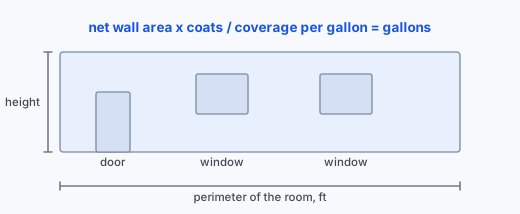
- Gross wall area: 384 square feet.
- Less one door and two windows: 51 square feet.
- Net wall area: 333 square feet.
- Primer, 1 coat at 400 square feet a gallon: 0.83 gallons exact, so buy 1 gallon.
- Paint, 2 coats at 350 square feet a gallon: 666 square feet of coverage, 1.9 gallons exact, so buy 2 gallons.
The paint side matches the 12x12 room page, which also covers the ceiling. The calculator prints a primer line on every run too, worked as one coat at whatever coverage you entered. For a primer that covers less than your paint, run it separately as above.
If you are still hanging the board, the drywall calculator counts the sheets, joint compound, tape and screws first.
Primer coverage is not paint coverage
Primer coverage can differ a lot from one product to the next. The two on the data sheets used here sit well apart: Sherwin-Williams lists 400 square feet a gallon for ProMar 200 Zero VOC primer at 4 mils wet, while USG lists 180 to 200 square feet a gallon for Sheetrock First Coat at 3 to 5 mils wet.
The same 333 square feet of walls, one coat of primer, at each coverage:
| Primer coverage | Gallons, exact | Buy |
|---|---|---|
| 400 sq ft per gallon | 0.83 | 1 gallon |
| 200 sq ft per gallon | 1.67 | 2 gallons |
| 180 sq ft per gallon | 1.85 | 2 gallons |
Paint calculator, 48 ft perimeter, 8 ft walls, 1 door, 2 windows, 1 coat. 400 is the Sherwin-Williams primer figure; 180 and 200 are the ends of the USG First Coat range. Read the coverage off your own primer's data sheet.
The difference between a gallon and two can come down to the product you pick, so check the sheet before you buy. The paint coverage chart lays out gallons by room size and coats for the paint itself.
Ceilings on new drywall
A new drywall ceiling gets the same treatment: one coat of primer and two of paint. The calculator works on walls, so enter the ceiling as its own area. For a 12 by 12 ceiling, enter a 12 foot perimeter, a 12 foot height and no doors or windows, which gives 144 square feet.
- Primer, 1 coat at 400 square feet a gallon: 0.36 gallons.
- Paint, 2 coats at 350 square feet a gallon: 288 square feet of coverage, 0.82 gallons.
USG's skim coat advice names ceilings as well as walls. If a ceiling faces critical lighting, the Level 5 approach applies there too.
A Level 5 ceiling done with Tuff-Hide can skip the paint: USG says that in ceiling applications where a flat white finish is wanted, it can be left unpainted.
Paint and primer in one on new drywall
The manufacturer sheets used here do not drop the primer on new drywall. Sherwin-Williams' drywall spec puts one coat of its primer under two coats of its wall paint.
USG's UltraLight panel sheet names one alternative to its own primer: an undiluted, interior latex flat paint with high solids content. So on that sheet a flat paint can serve as the prime coat if it fits the description. Before you count any paint as the primer, read what its own data sheet says about new drywall.
Prep and dry times between coats
Before priming, Sherwin-Williams says joint compound must be cured and sanded smooth, with all the sanding dust removed. USG adds that surfaces must be dry, clean and sound, and that any glossy surface must be dulled first.
Sherwin-Williams lists its ProMar 200 Zero VOC primer as dry to touch in 1 hour and ready to recoat in 4 hours at 77°F and 50 percent relative humidity. Its matching wall paint also recoats at 4 hours. USG First Coat dries to touch in under 30 minutes at 75°F and 50 percent humidity, and USG says to keep the air, the product and the surface at 55°F or warmer while you apply it and until it dries.
Sherwin-Williams notes that drying and recoat times depend on temperature, humidity and film thickness. A cold or damp room takes longer than the times on the sheet.
Paint calculator, Paint coverage chart, Drywall calculator. Free, no signup, nothing to install.
Questions people ask
Do I need two coats of primer on new drywall?
Usually not. The Sherwin-Williams drywall spec is one coat of primer and two of paint. Where light is critical or the paint is glossy, USG's answer is a skim coat of joint compound for a Level 5 finish, rather than a second coat of primer.
How much primer do I need for new drywall?
One coat over the net wall area, divided by your primer's coverage. A 12x12 room with 8 foot walls, one door and two windows has 333 square feet of wall. That is 0.83 gallons at 400 square feet a gallon, or 1.67 gallons at 200, so 1 gallon or 2.
How many coats of paint go on after primer?
Two. That is the drywall spec on both Sherwin-Williams sheets used here, and the paint sheet notes that priming plus two coats at the recommended film thickness helps where new drywall makes hiding a factor.
Can I use paint and primer in one on new drywall?
Check the product's data sheet first. Sherwin-Williams specs a separate primer coat under its paint on drywall. USG's UltraLight panel sheet accepts an undiluted, interior latex flat paint with high solids content as the prime coat.
How many coats on a new drywall ceiling?
The same: one coat of primer and two of paint. A 12 by 12 ceiling is 144 square feet, which the calculator puts at 0.36 gallons of primer at 400 square feet a gallon and 0.82 gallons of paint for two coats at 350.
How long does drywall primer take to dry before painting?
Sherwin-Williams lists 4 hours to recoat its ProMar 200 Zero VOC primer at 77°F and 50 percent humidity. USG First Coat dries to touch in under 30 minutes at 75°F and 50 percent. Both take longer in a cold or damp room.
Can I just prime the taped joints?
No. Sherwin-Williams says spot priming can leave a non-uniform final coat and recommends priming the whole surface. USG says to apply a full coverage coat of First Coat.
Sources
- Sherwin-Williams, ProMar 200 Zero V.O.C. Interior Latex Primer B28W12600, Product Data Sheet 108.24A, Drywall spec of 1 coat primer and 2 coats topcoat, 400 sq ft per gallon at 4 mils wet, touch 1 hour and recoat 4 hours at 77°F and 50 percent RH, prime the entire surface rather than spot prime, must be topcoated, joint compound cured and sanded.
- Sherwin-Williams, ProMar 200 Zero V.O.C. Interior Latex Eg-Shel, Product Data Sheet 101.83A, Drywall spec of 1 coat primer and 2 coats paint, coverage 350 to 400 sq ft per gallon, recoat 4 hours, and priming plus two coats where hiding or new drywall is a factor.
- USG, Sheetrock Brand First Coat Primer submittal sheet J1095, Joint banding and photographing from paper and compound differences, equalizing porosity and texture, full coverage coat, 180 to 200 sq ft per gallon, dry to touch under 30 minutes, 55°F minimum, not a final coating.
- USG, Sheetrock Brand Tuff-Hide Primer-Surfacer submittal sheet J1613, Level 1 to Level 5 finish chart, one spray coat in place of a skim coat plus primer for Level 5, applied only over a Level 4 finish, minimum Level 4 recommended., and can be left unpainted on a ceiling where a flat white finish is wanted.
- USG, Sheetrock Brand UltraLight Panels submittal sheet WB2501, Prime with First Coat or an undiluted, high solids interior latex flat paint; skim coat walls and ceilings under critical lighting or gloss paint; refer to GA-214 for the level of finish.