How Much Gravel Do You Need for a 10x12 Shed Base?
A 10x12 shed on a 12x14 gravel pad takes 3.8 tons of 3/4 inch crushed base at 4 inches, or 5.69 tons at 6 inches. See pad size, stone type and a size table.
Go straight to the gravel calculator Free, no signup. Read on if you want the detail first.The short answer: 3.8 tons at 4 inches
A 10x12 shed on a gravel pad 1 foot wider on every side needs 3.8 tons of 3/4 inch crushed base for a 4 inch compacted layer. That is 2.07 cubic yards in place, delivered as 2.93 loose cubic yards, because stone swells when it is dug and hauled.
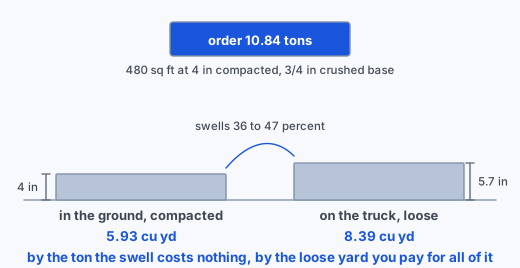
The pad is 12 by 14 feet, 168 square feet. At 4 inches, one ton of this stone covers about 44 square feet. The total weight is 7,591 pounds, well inside one 20 ton truck load, or 159 half cubic foot bags if you buy it bagged.
Order by the ton when you can. The gravel calculator uses 1.83 tons per compacted cubic yard, the midpoint of the 1.80 to 1.86 range Wisconsin DOT published for 3/4 inch dense graded base. The ends of that range move this order by about 0.06 tons either way.
How big the gravel pad should be
Ulrich Lifestyle Structures, a shed builder, tells buyers to make a free form gravel pad at least 1 foot larger than the building on every side. For a 10x12 shed that is the 12x14 pad in the answer above. On a sloped site Ulrich asks for at least 18 inches of margin all around, which makes the pad 13 by 15 feet, 195 square feet, and 4.41 tons at 4 inches.
If you frame the pad with a timber retaining wall, Ulrich's guide asks for a pad at least 3 feet longer and 3 feet wider than the footprint. For a 10x12 shed that is the same 13 by 15 foot pad and the same 4.41 tons at 4 inches.
Ulrich frames pads with pressure treated 4x4 or 6x6 timbers or railroad ties rather than boards set on edge. Its guide also says plainly that it is not an engineered set of specifications and that local code comes first.
Gravel under the 10x12 footprint alone is 2.71 tons at 4 inches, against 3.8 tons with the 1 foot border. Enter the pad size, not the shed size, when you run the calculator.
How deep: 4 inches or 6
Four inches is the starting depth in Ulrich's guide: for a free form pad it says to remove the top 4 inches of grass and soil, and for a framed pad to dig out at least 4 inches below the top of the box. That is the depth the short answer and the table below use.
Outdoor Living Today's foundation guide goes deeper. It says that for best results you excavate 6 inches and fill with gravel or crushed rock. At 6 inches the 12x14 pad takes 5.69 tons, which is 3.11 compacted cubic yards or 4.4 loose cubic yards, and weighs 11,387 pounds.
Ulrich says to place the stone in lifts of no more than 4 inches and compact each lift with a vibratory compactor or a hand tamper, fully, so the pad will not settle. A 6 inch pad therefore goes down as two lifts. The calculator lists one compactor day for this pad.
Level matters as much as depth. Suncast's shed manual asks for ground that slopes away from the foundation area, and Reeds Ferry shows the finished crushed stone completely level, like a table top. Dig deep enough that the finished pad is level and water runs away from it.
Gravel for common shed sizes
Every pad below is the shed plus 1 foot on each side, in 3/4 inch dense graded base. Loose cubic yards are what to order if your yard sells by volume instead of by the ton.
Gravel calculator, rectangle, 3/4 inch crushed base at 1.83 tons per compacted cubic yard:
| Shed | Pad | Tons at 4 in | Cu yd at 4 in, compacted / loose | Tons at 6 in | Cu yd at 6 in, compacted / loose |
|---|---|---|---|---|---|
| 6 x 8 | 8 x 10 | 1.81 | 0.99 / 1.4 | 2.71 | 1.48 / 2.1 |
| 8 x 8 | 10 x 10 | 2.26 | 1.23 / 1.75 | 3.39 | 1.85 / 2.62 |
| 8 x 10 | 10 x 12 | 2.71 | 1.48 / 2.1 | 4.07 | 2.22 / 3.14 |
| 8 x 12 | 10 x 14 | 3.16 | 1.73 / 2.45 | 4.74 | 2.59 / 3.67 |
| 10 x 10 | 12 x 12 | 3.25 | 1.78 / 2.52 | 4.88 | 2.67 / 3.77 |
| 10 x 12 | 12 x 14 | 3.8 | 2.07 / 2.93 | 5.69 | 3.11 / 4.4 |
| 10 x 16 | 12 x 18 | 4.88 | 2.67 / 3.77 | 7.32 | 4 / 5.66 |
| 12 x 16 | 14 x 18 | 5.69 | 3.11 / 4.4 | 8.54 | 4.67 / 6.6 |
| 10 x 20 | 12 x 22 | 5.96 | 3.26 / 4.61 | 8.95 | 4.89 / 6.92 |
Each row is one run of the gravel calculator with the pad length, width and compacted depth. A wider border or a framed pad needs its own run.
Bags are counted on the loose volume: the 12x14 pad at 4 inches is 159 half cubic foot bags, against 3.8 tons in bulk. At 6 inches it is 238 bags.
For areas that are not on this list, the gravel coverage chart gives cubic yards by area and depth. Take the tons from the calculator, because the chart converts at a general 2,800 pounds per cubic yard while the calculator uses the published weight of the stone you pick.
Which gravel to use
Use stone that compacts. Ulrich's guide names 21A or 21B as gravel that will compact, and tells you to avoid 57s or 58s, which it says tend to shift more, along with pea gravel or any other gravel that will not compact properly.
Reeds Ferry, another shed maker, calls for 3/4 inch crushed stone for drainage and leveling, and says not to use topsoil, loam or sand for the base.
The weight per yard depends on the stone. Wisconsin DOT's report measured select crushed material at 1.77 to 1.81 tons per compacted cubic yard. Pick it in the calculator and the 12x14 pad at 4 inches is 3.71 tons instead of 3.8. If your delivery ticket gives a tons per cubic yard figure, type it in and the calculator uses that instead of the published one.
Landscape fabric and compaction
Outdoor Living Today says to use landscape fabric under the gravel to prevent weed growth and soil shifting over time. The calculator lists 168 square feet of geotextile for the 12x14 pad, the same as its area.
Lay the fabric on the dug and leveled subgrade, then place and compact the stone in lifts on top of it.
Call your local utility before you dig. Outdoor Living Today's guide lists that step, and Suncast's manual has the same step for buried cables and pipes.
Gravel pad or concrete slab
Tuff Shed builds its floor joists to sit directly on dirt, gravel, grass, concrete or other firm, dry and level surfaces, and its installers level up to 4 inches for free. They do not dig to level, so a sloped yard needs the pad done first.
Suncast's manual for its resin shed allows a concrete slab at least 4 inches thick, with reinforcing bar recommended, or a wood platform on pier blocks or a footing. It ties the warranty to a properly constructed foundation that is square, flat and level.
A slab still needs stone under it. Outdoor Living Today places 4 inches of gravel as the base for a concrete slab. Under a 10x12 slab that is 2.71 tons of gravel, and the slab itself at 4 inches is 1.63 cubic yards with 10% waste in the concrete calculator, or 74 eighty pound bags.
If you would rather set the shed on blocks, the cinder blocks for a 10x10 shed page counts them. For a shed on piers, the post on how deep a deck footing should be covers how footing depth is set.
Tuff Shed and Outdoor Living Today both tell you to check with your town or local building code before you build, so ask what your building department wants under a shed of this size.
Gravel calculator, Gravel coverage chart, Cinder blocks for a 10x10 shed, Concrete calculator. Free, no signup, nothing to install.
Questions people ask
How deep should a gravel pad be for a shed?
Outdoor Living Today says to excavate 6 inches and fill with gravel or crushed rock for best results. Ulrich places the stone in compacted lifts of no more than 4 inches, so 6 inches goes down as two lifts. A 12x14 pad takes 3.8 tons at 4 inches and 5.69 tons at 6.
How big should a gravel pad be for a 10x12 shed?
At least 12 by 14 feet, 1 foot past the shed on every side, which is the minimum in Ulrich's guide for a free form pad. On a sloped site, or for a pad framed with a retaining wall, Ulrich's minimum grows to 13 by 15 feet, which takes 4.41 tons at 4 inches.
What size gravel is best for a shed base?
Stone that compacts. Ulrich names 21A or 21B and warns against 57 or 58 stone, which it says tends to shift more, and pea gravel. Reeds Ferry calls for 3/4 inch crushed stone. The gravel calculator defaults to 3/4 inch dense graded crushed base.
How many tons of gravel for a 10x12 shed?
3.8 tons for a 12x14 pad at 4 inches compacted, using 1.83 tons per cubic yard for 3/4 inch crushed base. At 6 inches it is 5.69 tons. Gravel under the 10x12 footprint alone is 2.71 tons at 4 inches.
Do I need landscape fabric under a shed gravel pad?
Outdoor Living Today recommends it, to prevent weed growth and soil shifting over time. For a 12x14 pad that is 168 square feet of fabric.
How much gravel for an 8x10 shed base?
2.71 tons at 4 inches on a 10x12 pad, 1 foot past the shed on every side. That is 1.48 compacted cubic yards or 2.1 loose. At 6 inches it is 4.07 tons.
Sources
- Ulrich Lifestyle Structures, How To Build A Gravel Pad, Pad at least 1 foot past the building, 18 inches on a sloped site, 3 feet longer and wider with a retaining wall, 4 inch dig, 21A or 21B stone, 57s, 58s and pea gravel to avoid, lifts of no more than 4 inches.
- Outdoor Living Today, How To Build A Foundation (PDF), Excavate 6 inches and fill with gravel, 4 inches of gravel under a slab, landscape fabric, compaction, call before you dig.
- Wisconsin DOT and Wisconsin Highway Research Program, report 0092-22-05, Weight-Volume Relationships and Conversion Factors for Soils and Aggregates of Wisconsin (December 2023), Table E2 tons per compacted cubic yard and compacted to loose expansion for dense graded base and select crushed material.
- Suncast, BMS6285T shed assembly manual (PDF), Slab at least 4 inches thick, wood platform option, ground sloped away, locate buried cables and pipes, foundation square, flat and level.
- Tuff Shed, Pre-Installation Guide, Floor joists can sit on dirt, gravel, grass or concrete; up to 4 inches of leveling; check with your municipality.
- Reeds Ferry Sheds, Site Preparation, 3/4 inch crushed stone for drainage and leveling, no topsoil, loam or sand.