Retainage on federal contracts
On federal fixed-price construction jobs, FAR 52.232-5 pays progress payments in full unless progress lags; then up to 10 percent may be held.
Open the free retainage calculator Free, no signup. Read on if you want the detail first.Short answer: paid in full unless progress slips
Retainage is not automatic on a federal fixed-price construction contract. Under FAR 52.232-5(e), a progress payment is paid in full when progress is satisfactory, and only when it is not may the contracting officer hold back up to 10 percent of that payment until progress recovers.
That is the reverse of retainage as it usually works, where a fixed percentage of every payment is held back, as the retainage term page explains. On a federal job the starting point is zero, and holding money is a decision the contracting officer makes, period by period, with a reason.
The clause is 52.232-5, Payments under Fixed-Price Construction Contracts. FAR 32.111(a)(5) tells contracting officers to insert it in solicitations and contracts for construction when a fixed-price contract is contemplated, so it is the payment clause to expect in a federal fixed-price construction contract.
What FAR 52.232-5(e) says, sentence by sentence
Paragraph (e) of the clause, in its May 2014 version, is four sentences long, and each one controls a different stage of the job. Paragraph (b) of the same clause provides for progress payments monthly or at more frequent intervals as the work moves forward, so this test is applied every payment period.
- Satisfactory progress: "If the Contracting Officer finds that satisfactory progress was achieved during any period for which a progress payment is to be made, the Contracting Officer shall authorize payment to be made in full." Full means nothing held.
- Slow progress: "However, if satisfactory progress has not been made, the Contracting Officer may retain a maximum of 10 percent of the amount of the payment until satisfactory progress is achieved." The word is may, and 10 percent is the ceiling, not the default.
- Substantial completion: "When the work is substantially complete, the Contracting Officer may retain from previously withheld funds and future progress payments that amount the Contracting Officer considers adequate for protection of the Government and shall release to the Contractor all the remaining withheld funds."
- Separately priced parts: "Also, on completion and acceptance of each separate building, public work, or other division of the contract, for which the price is stated separately in the contract, payment shall be made for the completed work without retention of a percentage."
None of the four sentences ties retainage to a percent complete. The clause text has no step down to 5 percent or to zero at 50 percent complete, so if a contract you are bidding has a rule like that, it comes from that contract's own terms, not from 52.232-5. Two more paragraphs of the clause touch the money held. Paragraph (g) says the retainage provisions in (e) do not apply to the part of a progress payment attributable to bond premiums. Paragraph (h) sets final payment: after completion and acceptance of all work, on a properly executed voucher and a release of all claims against the Government, except claims in stated amounts that you specifically except from the release.
The policy behind it: FAR 32.103
FAR 32.103 tells contracting officers how to use that power. It opens: "When satisfactory progress has not been achieved by a contractor during any period for which a progress payment is to be made, a percentage of the progress payment may be retained." Then it adds: "Retainage should not be used as a substitute for good contract management, and the contracting officer should not withhold funds without cause."
Decisions to retain, and how much, are made "by the contracting officers on a case-by-case basis", based on the contractor's past performance and the likelihood that it will continue. The cap reads: "The amount of retainage withheld shall not exceed 10 percent of the approved estimated amount in accordance with the terms of the contract", and the amount may be adjusted as the contract nears completion to recognize better than expected performance, the ability to rely on alternative safeguards and other factors. The section closes: "Upon completion of all contract requirements, retained amounts shall be paid promptly."
The FAR is being rewritten. The model text for the new Part 32, published under the FAR overhaul, keeps the same rule with must in place of shall: retainage only when progress is unsatisfactory, decided case by case, no more than 10 percent, adjustable for improved performance, and paid promptly once the contract is done.
Worked example: a $250,000 job at 60 percent
Take a $250,000 fixed-price federal job. The first progress payment comes at 50 percent complete and the second at 60 percent. The retainage calculator works out what is due on each application from the contract amount, the retainage rate, the percent complete and what has already been paid.
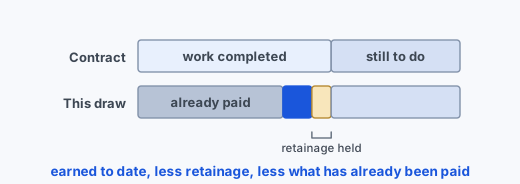
If progress is satisfactory both times, the rate is zero. The first application pays the whole $125,000.00 earned, and at 60 percent the second pays $25,000.00: $150,000.00 earned to date, less $125,000.00 already paid, with $0.00 held.
If the contracting officer found progress unsatisfactory both times and held the full 10 percent ceiling each time, the first application pays $112,500.00 and holds $12,500.00. At 60 percent the calculator shows $150,000.00 earned, $15,000.00 held, $112,500.00 already paid and $22,500.00 due on this application.
The second application, at 60 percent complete, both ways.
| Line | Progress satisfactory | Ceiling held on both payments |
|---|---|---|
| Retainage rate | 0% | 10% |
| Earned to date | $150,000.00 | $150,000.00 |
| Retainage held | $0.00 | $15,000.00 |
| Already paid | $125,000.00 | $112,500.00 |
| Due on this application | $25,000.00 | $22,500.00 |
| Held if that rate ran to completion | $0.00 | $25,000.00 |
Figures from the retainage calculator. A federal contracting officer decides each period separately, so a real job can carry retainage on some payments and none on others.
The calculator applies one rate to everything earned to date, which is how most private retainage clauses are written. Under 52.232-5(e) the hold is decided for each payment period, so if only one period was slow, only that payment carries retainage, and the right hand column is the ceiling, not the expected case. For the same contract with a flat 10 percent held from start to finish, see 10 percent retainage on a $250,000 contract.
When retained money comes back, and how fast
52.232-5(e) gives three release points: when satisfactory progress is achieved again, when the work is substantially complete (everything except what the contracting officer considers adequate protection), and on completion and acceptance of a separately priced building or division of the work. FAR 32.904(d)(1)(ii) adds: "The contracting officer must base the release of retained amounts on the contracting officer's determination that satisfactory progress has been made."
Once release is approved, the Prompt Payment clause sets the clock. Under 52.232-27(a)(1)(i)(B), retained amounts are due "as specified in the contract or, if not specified, 30 days after approval by the Contracting Officer for release to the Contractor." Ordinary progress payments are due 14 days after the designated billing office receives a proper payment request, and FAR 32.904(d)(1)(i)(B) lets the contracting officer specify a longer period in the solicitation and contract when more time is needed to inspect the work, with the justification documented.
Do not expect interest on money held while the job runs. Paragraph (a)(4)(ii) of the same clause says the prompt payment regulations at 5 CFR 1315.10(c) do not require interest penalties on "amounts temporarily withheld or retained in accordance with the terms of the contract."
Retainage between the prime and its subcontractors
The prime contractor's own subcontracts run on different rules. 52.232-27(c) requires the prime to put three clauses in each subcontract: (c)(1) a payment clause obligating the prime to pay the subcontractor for satisfactory performance not later than 7 days from receipt of payment, out of amounts paid to the prime; (c)(2) an interest penalty clause for payments made late; and (c)(3) a clause requiring the subcontractor to put the same two clauses in its own subcontracts.
Paragraph (d) then says those clauses do not impair the right to negotiate other subcontract terms, and (d)(1), headed Retainage permitted, covers terms that let the prime or a subcontractor retain, without cause, a specified percentage of each progress payment otherwise due to a subcontractor for satisfactory performance, without any obligation to pay a late payment interest penalty, on terms agreed by the parties and giving such recognition as they deem appropriate to the subcontractor's ability to furnish a performance bond and a payment bond. So a prime can hold a set percentage from a subcontractor even while the Government holds nothing from the prime, as long as the subcontract provides for it.
Two rules keep that money visible. Each progress payment request under 52.232-5(c)(3) carries the certification: "This request for progress payments does not include any amounts which the prime contractor intends to withhold or retain from a subcontractor or supplier in accordance with the terms and conditions of the subcontract." And under 52.232-27(h) the prime may not request payment from the Government of an amount withheld or retained from a subcontractor until it has determined and certified to the contracting officer that the subcontractor is entitled to it. Withholding for cause is a separate step: paragraph (g) requires a written notice of any withholding to the subcontractor, with a copy to the contracting officer, stating the amount, the specific causes under the subcontract and the remedial actions the subcontractor must take to be paid.
Put the agreed percentage and the release terms in writing in the subcontract itself. The subcontractor agreement template is a starting point for that paperwork.
Bonds, state jobs and what this clause does not cover
Bonds are a separate protection. FAR 28.102-1(a) says "40 U.S.C. chapter 31, subchapter III, Bonds (formerly known as the Miller Act), requires performance and payment bonds for any construction contract exceeding $150,000", subject to listed waivers, and under (b)(1), for construction contracts over $35,000 up to $150,000, the contracting officer selects two or more payment protections, such as a payment bond or an irrevocable letter of credit. Neither paragraph mentions retainage.
State, local and private jobs are not governed by the FAR. The amount held there comes from the contract and from state rules, and the retainage chart shows what a fixed percentage comes to at eleven contract values and five rates.
Contract terms vary from job to job and the FAR itself is being rewritten, so have a licensed attorney confirm how these rules apply to your specific contract.
Retainage calculator, What is retainage, Retainage chart, Subcontractor agreement template. Free, no signup, nothing to install.
Questions people ask
Is retainage required on federal contracts?
No. On a fixed-price construction contract, FAR 52.232-5(e) says the contracting officer shall authorize payment in full when progress is satisfactory. Retainage of up to 10 percent of a payment is allowed only when progress has not been satisfactory, and FAR 32.103 says funds should not be withheld without cause.
When is retainage released on a federal contract?
When satisfactory progress is achieved again, at substantial completion (except what the contracting officer keeps as adequate protection), and on acceptance of a separately priced building or division of the work. Released retainage is due as the contract says or, if it says nothing, 30 days after the contracting officer approves the release.
Can a prime contractor hold retainage from a subcontractor on a federal job?
Yes, if the subcontract provides for it. FAR 52.232-27(d)(1) lets the prime retain, without cause, a specified percentage of each progress payment otherwise due, without owing late payment interest. The prime cannot bill the Government for that held amount until it certifies the subcontractor is entitled to it.
Does the Miller Act cover retainage?
The bond rule in FAR 28.102-1 requires performance and payment bonds on construction contracts over $150,000 and does not mention retainage. Retainage comes from the payment clause, 52.232-5, and from subcontract terms. Whether a payment bond claim can reach unpaid retainage is a question for a construction attorney.
Does the Government pay interest on retainage?
Not while it is properly held. FAR 52.232-27(a)(4)(ii) says the prompt payment regulations do not require interest penalties on amounts temporarily withheld or retained in accordance with the terms of the contract. The clause does set a due date once the release is approved.
Can federal retainage be more than 10 percent?
During the job, FAR 52.232-5(e) caps it at 10 percent of the payment, and FAR 32.103 at 10 percent of the approved estimated amount. At substantial completion the contracting officer may keep, from withheld funds and future payments, the amount it considers adequate protection and must release the rest. The text does not set a percentage for that amount.
Sources
- FAR 52.232-5, Payments under Fixed-Price Construction Contracts (May 2014), Paragraph (e) Retainage; (b) progress payments; (c)(3) the subcontract certification; (g) bond premiums; (h) final payment.
- FAR 32.103, Progress payments under construction contracts, Case by case decisions, no withholding without cause, the 10 percent cap, prompt payment of retained amounts.
- FAR 52.232-27, Prompt Payment for Construction Contracts (Jan 2017), Due dates for progress payments and released retainage, no interest on amounts retained under the contract, subcontract payment and retainage rules.
- FAR 32.904, Determining payment due dates, Paragraph (d), construction contracts.
- FAR 32.111, Contract clauses for non-commercial purchases, Paragraph (a)(5) prescribes 52.232-5 for fixed-price construction.
- FAR 28.102-1, General (bonds for construction), Performance and payment bonds above $150,000; payment protections from $35,000 to $150,000.
- FAR Overhaul, Part 32 model deviation text, The rewritten 32.103 keeps the 10 percent cap and the satisfactory progress test.