How Much Gravel Do You Need for a French Drain?
A French drain 50 ft long, 12 in wide and 18 in deep holds 2.78 cubic yards of gravel. Size your trench and turn yards into tons with your supplier's figure.
Open the free gravel calculator Free, no signup. Read on if you want the detail first.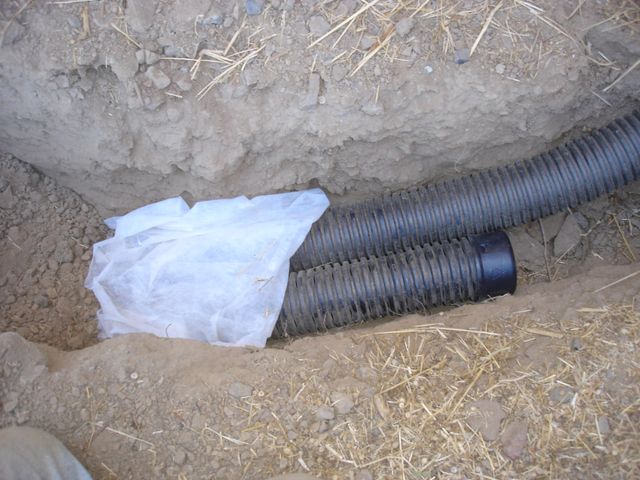

The short answer: 2.78 cubic yards for 50 feet
A French drain 50 feet long, 12 inches wide and 18 inches deep holds 2.78 cubic yards of gravel. At the same width and depth, every 10 feet of trench holds 0.56 cubic yards.
Those are volumes in place, from the gravel calculator with the shape set to Rectangle, or a trench. Tons depend on the stone. With the material set to Washed drain rock, No. 57, the calculator prints about 3.83 tons for this trench from a federal lab figure, and your supplier's own figure, which it takes in a field of its own, is better still. The worked example below shows how.
The 12 by 18 inch size follows the Northern Virginia Soil and Water Conservation District, which says a standard French drain ditch is about 1.5 feet deep and 10 to 12 inches wide, varying with the pipe size, usually 4 to 6 inches, and the depth you want.
Measure the trench: length, width, depth
Length is the run you will dig, in feet, from the high end to the outlet. A branch of the same width and depth can be added to the main length. A branch of a different size gets its own run.
Width is the width of the trench as dug. The calculator takes width in feet, so 12 inches is 1 and 6 inches is 0.5.
Depth goes in inches, in the field the calculator labels Compacted depth. For a drain, enter the depth of the stone. If the top few inches will be topsoil and sod instead of gravel, take them off the trench depth first.
Gravel by trench size
Cubic yards of stone in place, from the gravel calculator with each trench entered as a rectangle. Tons are left out on purpose, because they depend on the stone your yard sells.
| Trench, width x depth | Length | Cubic yards in place |
|---|---|---|
| 12 in x 18 in | 10 ft | 0.56 |
| 12 in x 18 in | 25 ft | 1.39 |
| 12 in x 18 in | 50 ft | 2.78 |
| 12 in x 18 in | 75 ft | 4.17 |
| 12 in x 18 in | 100 ft | 5.56 |
| 12 in x 24 in | 50 ft | 3.7 |
| 12 in x 24 in | 100 ft | 7.41 |
| 6 in x 18 in | 50 ft | 1.39 |
| 6 in x 18 in | 100 ft | 2.78 |
Volume in place is the whole trench. The pipe takes a small part of it, covered further down.
Width drives the order as hard as length does. 100 feet of a 6 by 18 inch trench holds the same 2.78 cubic yards as 50 feet of a 12 by 18 inch one, so a narrow trencher saves real stone.
Depth costs stone as well: taking the 50 foot trench from 18 to 24 inches deep raises it from 2.78 to 3.7 cubic yards. For a pad or patio base instead of a trench, the gravel coverage chart lists yards and tons by area and depth.
Worked example: from cubic yards to tons
Take a trench 50 feet long, 12 inches wide and 18 inches deep. In the gravel calculator, set Shape to Rectangle, or a trench, Length to 50, Width to 1, Compacted depth to 18, Material to Washed drain rock, No. 57 and Fabric to Wrapped around a trench. The row Volume in place reads 2.78 cu yd.
Now the weight. With the ticket field left at 0, the calculator uses 1.38 tons a cubic yard and prints 3.83 tons. That is the midpoint of 1.29 to 1.47, converted from a Federal Highway Administration lab study that weighed a No. 57 stone at 95.4 pounds a cubic foot at its loosest and 108.7 at its densest. One quarry's stone is not every quarry's, so the calculator warns that the tonnage can be out by about 6.5 percent either way, 0.25 tons on this trench.
For the order, ask the yard what one cubic yard of its washed drain rock weighs in tons, or read it off the scale ticket from an earlier load. Type that number into the field labeled Tons a cubic yard from your ticket. As an example only, a figure of 1.5 turns the same trench into 4.17 tons, and a figure of 1.4 turns it into 3.89 tons.
A figure of 1.5 sits outside the 1.29 to 1.47 range, so the calculator flags it. Quarries do vary and the yard's number may well be right. The check that matters is the one in the same warning: make sure the number is tons per cubic yard and not pounds per cubic foot.
Read the volume in place, not the loose yards
With crushed base chosen, the calculator's Order by the loose cubic yard row adds the 36 to 47 percent swell of 3/4 inch base between the truck and a rolled layer, and would print 3.93 cu yd for this trench. With Washed drain rock, No. 57 chosen it prints 2.78, the same as the volume in place, because drain stone is not rolled.
A French drain is not built that way. The conservation district's steps are to line the ditch with fabric, lay gravel in the bottom, set the perforated pipe on it and surround the pipe with gravel on the sides and top. None of those steps compacts the stone. Order on the 2.78 cubic yards in place, and when the yard sells by the ton, convert with its own tons per cubic yard as shown above.
The drain rock choice also drops the two lines written for a compacted base, the note about compacting in 4 inch lifts and the compactor day in the printed list. Its bag count, 150 half cubic foot bags for this trench, is figured on the 2.78 cubic yards in place.
Subtract the pipe, or leave it in
The perforated pipe sits inside the stone, so it takes up part of the trench. A 4 inch pipe, figured at 4 inches across, fills about 4.36 cubic feet over 50 feet, roughly 0.16 cubic yards.
That is a small share of the 2.78 cubic yards. Order the full trench volume anyway: it leaves a small margin of stone instead of a shortfall, and a short load means a second delivery charge.
Which gravel to order
The conservation district's page calls for gravel and does not name a size. Oregon State University Extension's fact sheet on soakage trenches covers a close cousin: a trench lined with geotextile and filled with rock that stores runoff in the spaces between the stones. It says that rock should be crushed, washed, uniform and durable, with no fine material such as slate, shale, clay, silt or organic matter, and puts its pore space at about 40 percent.
That is why the calculator's default stone, dense graded crushed base, is the right pick under a 10x12 shed and the wrong one in a drain. Base is meant to pack into a firm layer. Drain stone is meant to leave open space for water.
At the yard, ask for washed drain rock or washed clean stone, and ask which size they sell for drains. If it is No. 57, pick Washed drain rock, No. 57 in the calculator, and either way get the yard's weight per cubic yard for the ticket field.
Fabric, pipe and slope
The Northern Virginia Soil and Water Conservation District's building tips: line the ditch on all sides with landscape fabric, place a layer of gravel at the bottom, lay a perforated plastic pipe on that gravel and surround it with gravel on the sides and top. If topsoil and sod will cover the drain, pull the fabric over the top of the gravel before the topsoil goes on. If the gravel stays exposed at the surface, the fabric does not need to close over the top, but protect its edges.
Fabric for the 12 by 18 inch example has to cover the floor, both walls and the top, a strip 1 + 1.5 + 1.5 + 1 = 5 feet wide, or 250 square feet over 50 feet. Oregon State's soakage trench sheet, written for that related practice, says fabric segments should overlap by 12 inches. Set Fabric to Wrapped around a trench and the gravel calculator adds that 1 foot of overlap where the fabric closes on top: 2 times the width plus 2 times the depth plus 1 foot, times the length, which is 6 by 50 = 300 square feet here. Seams where one roll meets the next need their own overlap on top of that. Left on Under the base, it counts the floor only, 50 square feet.
Slope: Clemson Cooperative Extension's Home and Garden Information Center says to maintain a 1% slope along the trench when digging. One percent is a fall of 1 foot over 100 feet of trench, so 6 inches over the 50 foot example. For which way the pipe's holes face, follow the instructions printed by the pipe's maker.
Outlet: the district says a French drain carries runoff underground to a suitable outlet, and cautions that redirected runoff has to go to a suitable outlet and can affect neighboring properties.
Ordering: bulk, bags and the call before you dig
Short drains sit near the delivery minimum. A 10 foot run at 12 by 18 inches is 0.56 cubic yards in place, and for that size the calculator warns that most yards have a minimum delivery of one to three yards plus a haul charge. Ask the yard for its minimum, and for the price of its washed stone in bags, before you choose.
Before any digging, call 811. The Pipeline and Hazardous Materials Safety Administration says the call is free, there is no cost for having the underground lines marked, and every digging project needs the call, even small ones like planting trees or shrubs. It also says all states require by law that you call 48 to 72 hours before digging.
Gravel calculator, Gravel coverage chart, Square footage calculator, Gravel for a 10x12 shed base. Free, no signup, nothing to install.
Questions people ask
How many tons of gravel for a 100 ft French drain?
A 100 foot trench 12 inches wide and 18 inches deep holds 5.56 cubic yards of stone. Tons are that volume times your supplier's tons per cubic yard. With Washed drain rock, No. 57 chosen and the ticket field at 0, the gravel calculator prints 7.65 tons from a federal lab figure, and at an example figure of 1.5 tons a yard it prints 8.33. The yard's own figure for its stone is the one to order from.
Do I need gravel under the pipe in a French drain?
Yes. The Northern Virginia Soil and Water Conservation District's steps put a layer of gravel at the bottom of the ditch, then the perforated pipe on top of it, then gravel on the sides and top of the pipe. The page does not give a thickness for the bottom layer, and the trench depth you enter in the calculator already includes it.
What size gravel is best for a French drain?
Neither the conservation district nor Clemson Extension names a size. Oregon State University Extension's soakage trench fact sheet asks for rock that is crushed, washed, uniform and durable with no fines. Ask your yard which washed stone it sells for drains and what a cubic yard of it weighs.
How deep should a French drain be?
The conservation district puts a standard French drain ditch at about 1.5 feet deep and 10 to 12 inches wide, varying with the pipe size and the depth you need, and notes that deeper French drains can also drain groundwater. Depth costs stone: 50 feet at 12 by 24 inches holds 3.7 cubic yards against 2.78 at 18 inches.
How do I use the gravel calculator for a French drain?
Choose Rectangle, or a trench, and set Material to Washed drain rock, No. 57. Enter the length in feet, the width in feet (1 for 12 inches) and the depth in inches. Read Volume in place for cubic yards and Order by the ton for tons, and put your supplier's tons per cubic yard in the ticket field when you have it. Set Fabric to Wrapped around a trench for the fabric that lines the trench and closes over the top.
Is the pipe's volume worth subtracting?
Rarely. A 4 inch pipe figured at 4 inches across fills about 0.16 cubic yards over 50 feet, a small share of the 2.78 cubic yards in a 12 by 18 inch trench. Ordering the full trench volume leaves a small margin instead of a short load.
Sources
- Northern Virginia Soil and Water Conservation District (Fairfax County), Control Heavy Runoff: Solving Drainage and Erosion Problems, French drain ditch size, fabric, gravel and pipe placement, suitable outlet
- Clemson Cooperative Extension, Home and Garden Information Center, Dealing With Spring Drainage (2020), 1% slope along the trench
- Oregon State University Extension Service, EM 9204, Low-Impact Development Fact Sheet: Soakage Trenches (May 2018), Storage rock crushed, washed, uniform and durable, no fines, about 40 percent pore space; fabric segments overlap by 12 inches
- Federal Highway Administration, FHWA-HRT-15-034, Strength Characterization of Open-Graded Aggregates for Structural Backfills (2015), Table 7, No. 57 stone minimum and maximum unit weight, 95.4 and 108.7 pounds per cubic foot, the source of the calculator's drain rock figure
- Pipeline and Hazardous Materials Safety Administration, Call Before You Dig!, 811 is free; states require the call 48 to 72 hours before digging