How Many Cinder Blocks Do You Need for a Fire Pit?
A 36 inch fire pit three courses high takes 28 standard 8x8x16 cinder blocks with 5% waste. Counts for 36 to 48 inch rings, plus the steel ring and pad.
Open the free block calculator Free, no signup. Read on if you want the detail first.

The short answer: 28 blocks for a 36 inch ring
A round fire pit with a 36 inch inside diameter, three courses of standard 8x8x16 block high, takes 28 blocks with 5% waste, or 26 before waste. A wider ring or a fourth course takes more, and the table below runs 36, 40, 44 and 48 inch rings at three and four courses.
Every count here is the block calculator run as a plain wall with no openings and no grouted cells. The one number you work out yourself is how long that wall is, and on a circle that takes one step.
Turn the circle into a wall length
A block calculator measures walls, so unroll the ring into one. Measure around the middle of the block, not the inside face, because the inside of a ring is shorter than the outside and the centerline sits between them.
A standard block is 7 5/8 inches wide and 15 5/8 inches long, and with a 3/8 inch joint it lays out as a nominal 8 by 16, per the Concrete Masonry and Hardscapes Association. Half a nominal block width on each side adds 8 inches to the inside diameter, so a 36 inch ring has a 44 inch centerline circle. Multiply 44 by pi and divide by 12 for feet: 11.52 feet of wall.
Type 11.52 for the length and 2 for the height, since three 8 inch courses make 24 inches. Set openings to 0, block width to 8 inch, grouted cells to None, and waste to 5%. The calculator returns 23 square feet of wall, 26 blocks before waste at 1.125 blocks a square foot, and 28 blocks to buy.
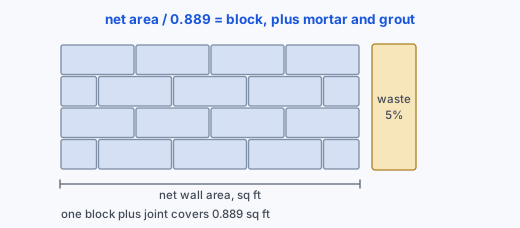
The result also lists mortar, joint reinforcement and rebar. A dry stacked pit needs none of them, so skip those lines. If you would rather mortar the joints, the same run calls for 1.2 cubic feet of mortar, which it turns into 2 bags of 80 lb mortar mix.
This is the same centerline method as the 4x8 raised garden bed, only bent into a circle.
Blocks by ring size and height
Each count is the block calculator's output for that length, with standard 8 inch block and no fill. Three courses is 2 feet of height. Four courses is 32 inches, typed as 2.6666 feet.
| Inside diameter | Length to type | 3 courses, before waste | 3 courses, with 5% waste | 4 courses, before waste | 4 courses, with 5% waste |
|---|---|---|---|---|---|
| 36 in | 11.52 ft | 26 | 28 | 35 | 37 |
| 40 in | 12.57 ft | 29 | 30 | 38 | 40 |
| 44 in | 13.61 ft | 31 | 33 | 41 | 43 |
| 48 in | 14.66 ft | 33 | 35 | 44 | 47 |
Each length is the inside diameter plus 8 inches, times pi, divided by 12. A ring wider than 36 inches has room for a fire bigger than the 3 foot recreational fire limit covered further down.
Straight blocks on a curve
A standard block is a rectangle, so on a tight circle the inside corners of neighboring blocks touch while the outside corners open into wedge shaped gaps. The calculator counts by area along the centerline and rounds up, so use its figure as the budget, not as a promise of the exact number that closes the ring.
Drive a stake at the center, lay the first course dry around it, and count what actually closes the circle before you buy or stack the rest. Then stagger the joints as you go up, setting each block over the joint between two blocks below it, the way the Natural Concrete Products kit instructions lay their second course.
Fire pit kits and retaining wall block
Fire pit kits are built from retaining wall units laid to a set radius, so count kit block from the kit's own layout rather than from wall area.
Natural Concrete Products' 30 inch fire pit kit is one example. Its instructions say the first course may need shifting slightly to get a tight fit between all the blocks. They lay 8 blocks a course for two courses, set on a 16 inch radius from a center stake to the center of the back of each block, and finish with 8 caps. The top course and the caps are glued down with concrete adhesive.
Keep the fire off the block
The Natural Concrete Products kit instructions say the steel ring and rock are there to dissipate heat because concrete blocks can crack at high temperatures, and the kit's care sheet adds that excessive heat can make the blocks and caps crack or blacken. Its blocks are retaining wall units made to ASTM standards, so even block sold for a fire pit gets a steel ring between it and the fire.
In that kit, about 2 inches of clean porous rock or gravel goes inside the pit, the steel ring sits in the center of the blocks, and more clean porous rock or gravel fills the space between the ring and the block.
The same instructions say to keep the fire inside the steel ring, not to burn a fire too big for the pit, and not to burn synthetic materials. For seasonal maintenance the care sheet says to replace or add gravel at the bottom and sides of the steel ring. Buy the ring before you lay out the blocks, so the circle is sized to go around it with room for that gravel.
The pad under the ring
The kit instructions start with a level pad of gravel or rock on compacted soil, its top 1 inch below grade, a 48 inch circle for their 30 inch kit. They also say to call your local utilities to mark buried cables and pipes before you dig.
A 36 inch ring of 8 inch block is more than 4 feet across on the outside once you add a block width on each side, so a 5 foot circle of base leaves a margin all around. In the gravel calculator, choose Circle, type 5 for the diameter, keep the default 4 inch depth and pick 3/4 inch crushed base.
It returns 20 square feet, 0.24 cubic yards compacted and 0.44 tons to order, about 887 lb, or 19 half cubic foot bags if you buy it bagged. At that size the calculator itself warns that bags may cost less than a delivery minimum. The steps are the same as for a shed base, only round.
How far from the house, and how big a fire
Where a city has adopted the International Fire Code, distance comes from its Section 307 as that city adopted it. Aurora Fire Rescue in Colorado sums up its adopted edition like this. A recreational fire, which is what a fire pit holds, cannot be within 25 feet of a structure or combustible material, and is limited to 3 feet across and 2 feet high. Portable outdoor fireplaces, the self contained kind, must be at least 15 feet from a structure or combustible material and used to the maker's instructions.
The same bulletin quotes the attendance rule. The fire has to be attended until it is out, with at least one portable fire extinguisher rated at least 4-A, or other approved means such as dirt, sand, a water barrel or a garden hose, ready to use. The fire code official can order a fire put out when it creates or adds to a hazardous or objectionable situation, and Aurora lists Red Flag days and Air Quality Index days of red or higher as times when open burning is prohibited. The fire extinguisher toolbox talk covers how many extinguishers a job site needs and how far anyone should have to walk to one.
A 36 inch inside diameter keeps the fire's width inside that 3 foot limit by the shape of the pit, though the 2 foot height limit is still up to you. A 44 or 48 inch ring does not, so on a wider pit you have to keep the fire smaller than the pit yourself. Your city may run a different edition or its own amendments, so ask your fire department before you build.
Block calculator, Gravel calculator. Free, no signup, nothing to install.
Questions people ask
Can you use cinder blocks for a fire pit?
Yes, as the outer wall, but not as the part that holds the fire. Natural Concrete Products' fire pit kit instructions warn that concrete blocks can crack at high temperatures, and the kit uses a steel ring with rock between the ring and the block to carry the heat. Build the block around a steel ring and keep the fire inside it.
Can I use retaining wall blocks for a fire pit?
Yes. Natural Concrete Products' 30 inch kit is built from retaining wall units: 8 blocks a course for two courses plus 8 caps, laid to a 16 inch radius. For any other kit, count from the maker's layout, since the block calculator's wall area method is for standard block. That kit still puts a steel ring between the fire and the blocks.
Do you need mortar for a cinder block fire pit?
The Natural Concrete Products kit instructions stack the courses dry with staggered joints and glue only the top course and the caps with concrete adhesive. If you want mortared joints anyway, the block calculator lists 1.2 cubic feet of mortar, 2 bags of 80 lb mix, for a 36 inch ring three courses high.
How far should a fire pit be from the house?
Under Section 307 of the International Fire Code as Aurora, Colorado adopted it, 25 feet from any structure or combustible material for a recreational fire, and 15 feet for a portable outdoor fireplace. Cities adopt different editions and amendments, so check with your local fire department.
How many blocks for a four course fire pit?
37 blocks for a 36 inch ring with 5% waste, 35 before waste. Type 11.52 feet for the length and 2.6666 feet for the height in the block calculator. A 48 inch ring at four courses takes 47 with waste.
How much gravel goes inside the fire pit?
Natural Concrete Products' kit instructions call for about 2 inches of clean porous rock or gravel inside the pit, plus more of the same filling the gap between the steel ring and the blocks.
Sources
- Concrete Masonry and Hardscapes Association, CMU-TEC-002-23, Weights and Section Properties of Concrete Masonry Assemblies, Specified dimensions of a nominal 8x8x16 unit, 7.625 by 7.625 by 15.625 inches, and the 3/8 inch mortar joint.
- Aurora Fire Rescue, City of Aurora, Colorado, Fire Pits, Outdoor Fireplaces and Chimineas, IFC Section 307 as adopted in Aurora: 25 feet and the 3 by 2 foot size limit for recreational fires, 15 feet for portable outdoor fireplaces, attendance and the 4-A extinguisher.
- Natural Concrete Products, 30 inch Fire Pit Kit installation instructions, Pad, block layout, steel ring, rock fill, adhesive on the top course, the warning that concrete blocks can crack at high temperatures, and the care sheet on heat and seasonal gravel.